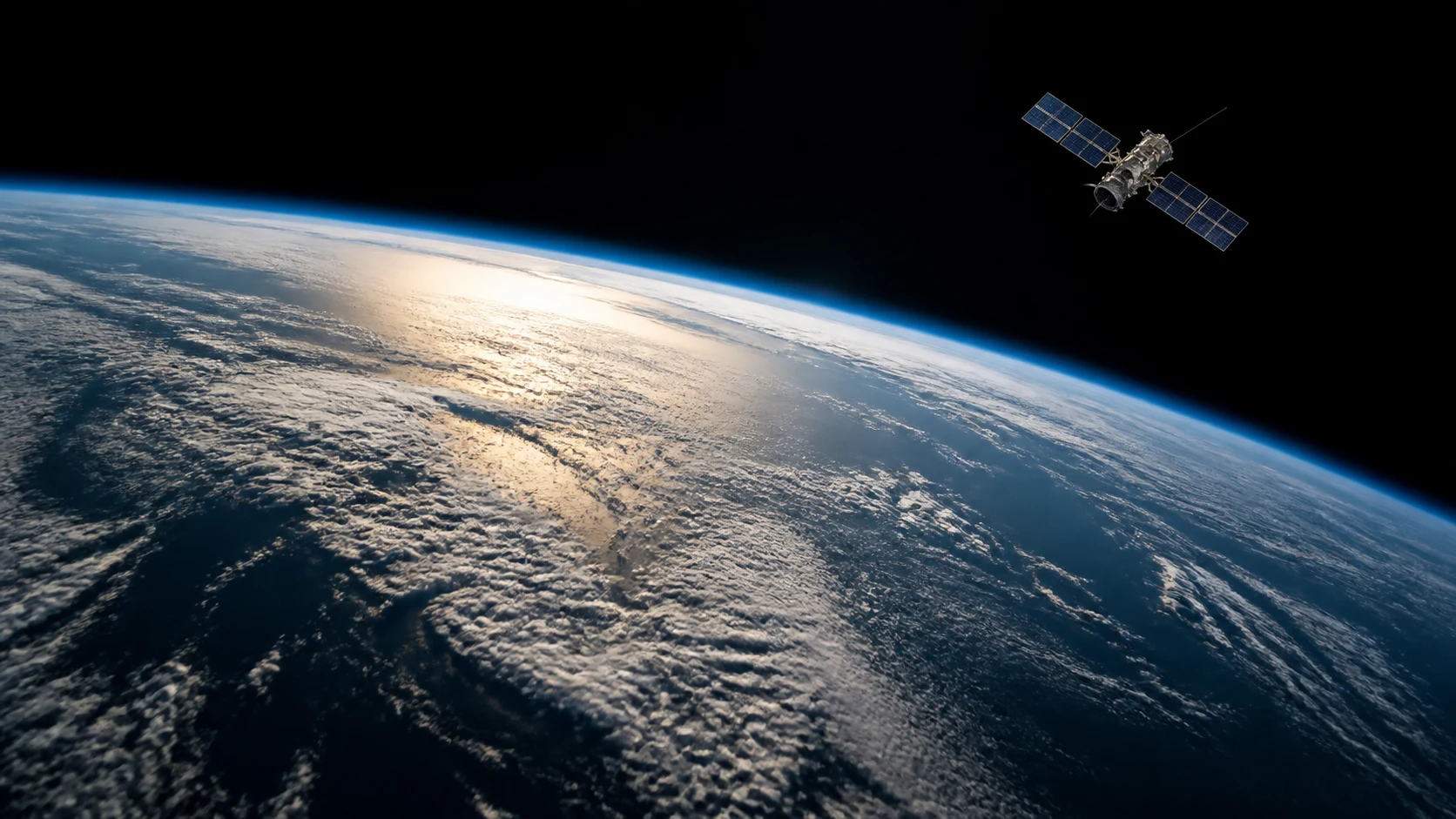

NASA has selected a new mission concept to investigate how changes in Earth’s lower atmosphere influence the space environment above it. The DAPHNE mission, short for Dynamic Atmosphere-Ionosphere Explorer, is entering Phase B of development, where engineers and scientists will refine the mission design and plan its future operations.
The announcement matters because space weather is not shaped by the Sun alone. Earth’s upper atmosphere is also affected by energy and waves rising from the atmosphere below. DAPHNE is designed to study that connection using two identical satellites that can make coordinated measurements from separate locations.
What NASA has selected
According to NASA’s official announcement, DAPHNE will examine the thermosphere and ionosphere, the region where Earth’s neutral atmosphere transitions into the electrically charged plasma of space. This thin shell around the planet is constantly changing under the influence of solar activity, lower-atmosphere dynamics and conditions in near-Earth space.
The mission will measure neutral winds, temperature and atmospheric composition in the thermosphere. By combining those observations with information about energy moving upward from the lower atmosphere, researchers hope to improve the physical understanding behind space-weather forecasting.
That objective is different from simply monitoring solar flares or geomagnetic storms after they begin. DAPHNE is intended to clarify how the atmosphere responds as energy travels through it, and how processes originating lower down can influence the region where space weather is observed.
Why the upper atmosphere matters
The ionosphere and thermosphere are far above the weather systems people experience at the surface, but they are important to modern infrastructure. Changes in this region can affect the near-Earth space environment, including the conditions experienced by low-Earth-orbit satellites. NASA also identifies GPS technology and astronauts as areas where better space-weather knowledge could be valuable.
For satellite operators, the benefit would be improved scientific context for interpreting changes in the upper atmosphere. For mission planners, a more complete picture could help explain when the space environment is becoming more challenging for spacecraft and crews. Those are potential benefits of the research, not operational capabilities that exist today.
DAPHNE’s twin-spacecraft design is central to that approach. Measurements taken at more than one point can help researchers distinguish changes moving through the atmosphere from conditions that are local to a single spacecraft. The paired observations are expected to support a more detailed view of how atmospheric disturbances develop and propagate.
What remains unconfirmed
NASA’s announcement describes DAPHNE as a selected mission concept, not as a mission with a confirmed launch date. The project must undergo a confirmation review in 2027. That review will assess the mission’s progress and the availability of funding.
If NASA confirms the mission, the agency says its total estimated cost, excluding launch, will not exceed $250 million in fiscal year 2023 dollars. NASA also states that a launch would occur no earlier than 2029. Both points are conditional: neither represents a guaranteed budget, launch date or flight schedule at this stage.
The mission is led by Aimee Merkel of the Laboratory for Atmospheric and Space Physics at the University of Colorado Boulder. NASA’s Goddard Space Flight Center provides funding and management oversight through the Solar Terrestrial Probes program. DAPHNE was proposed in response to NASA’s DYNAMIC mission announcement of opportunity.
A measured step toward better forecasting
The practical promise of DAPHNE is better evidence about the boundary between terrestrial weather and space weather. Forecasting improvements will depend on the quality of the measurements, the mission’s eventual confirmation and the scientific work that follows. The selection therefore marks an important development, but not a completed forecasting system.
For now, the confirmed news is narrower and more useful: NASA has chosen DAPHNE to advance into Phase B, with a twin-satellite plan focused on the thermosphere and ionosphere. The mission’s next major test will be the 2027 confirmation review, which will determine whether the concept proceeds toward flight.