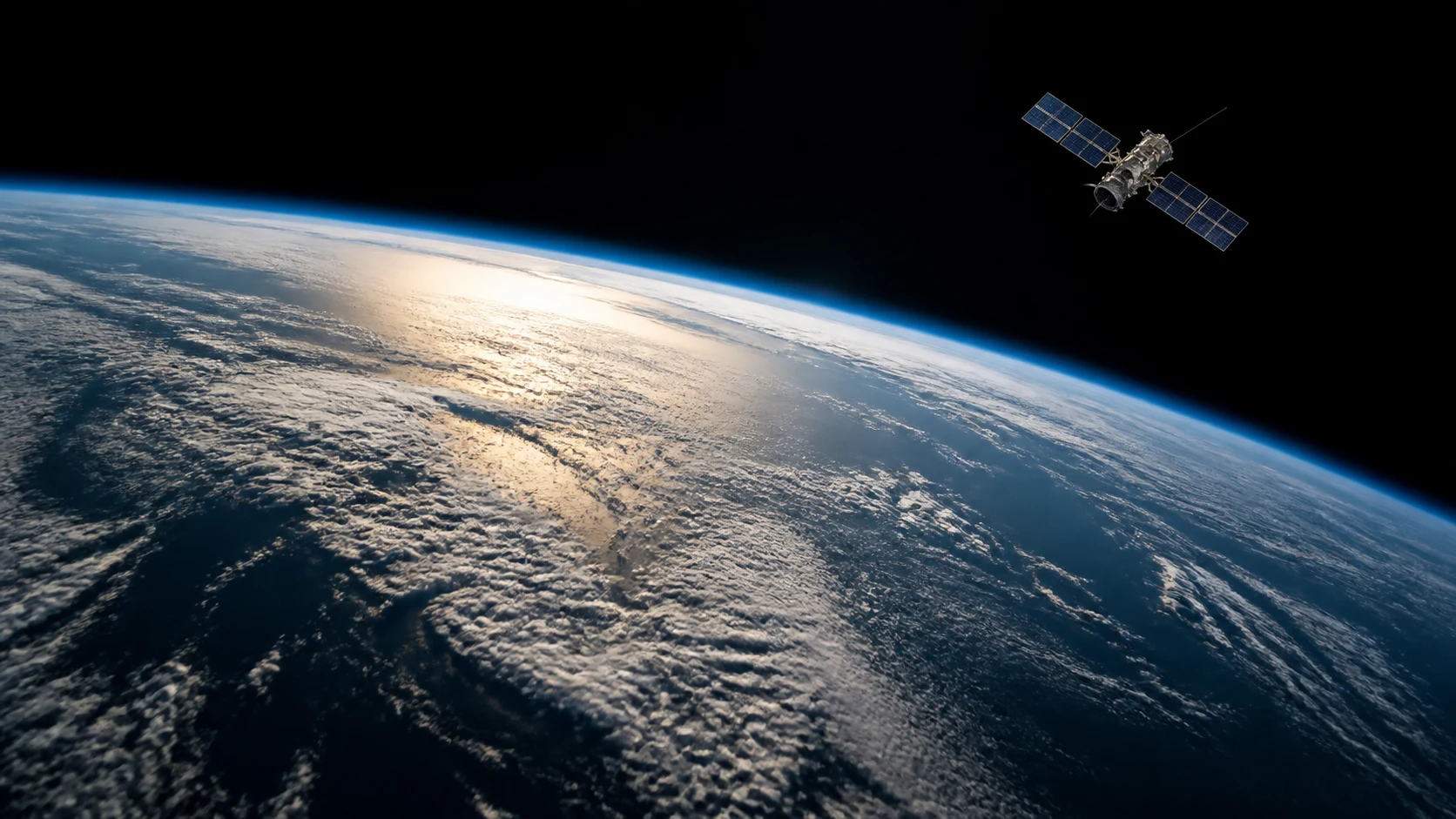

NASA has reported the first science measurements from CLARREO Pathfinder, an instrument aboard the International Space Station designed to improve the accuracy of Earth-observing data. The milestone, announced on July 10, marks the instrument’s first successful collection of reflected sunlight from space and moves the mission into its commissioning phase.
CLARREO Pathfinder is a hyperspectral imaging spectrometer. Instead of recording only a small number of broad color channels, it measures reflected sunlight across hundreds of wavelength bands. Those measurements can reveal distinct optical signatures from clouds, ocean water, ice, vegetation, soil and other surfaces. NASA describes the instrument as a potential calibration reference for other Earth-observing sensors.
The first observation crossed western Canada, capturing a combination of ocean, land and clouds. The measurement lasted five continuous minutes and produced a strip approximately 43.5 miles wide and 1,367 miles long. The observation path began over the Pacific Ocean west of Canada and extended inland to just east of Calgary, Alberta.
NASA’s official account of the first measurements includes a true-color composite and a hyperspectral data cube. The composite offers a familiar visual view of the scene, while the data cube shows how the same landscape reflects light differently at many wavelengths. In that representation, vertical stripes correspond to individual locations and horizontal layers represent different parts of the measured spectrum.
Why the measurement matters
Earth-observation satellites are used to monitor changes in the atmosphere and on the surface, but instruments do not all measure light in exactly the same way. Differences in calibration can make it harder to compare observations collected by separate missions or to identify long-term trends that depend on small changes in the data.
CLARREO Pathfinder is intended to address that problem by making highly accurate measurements anchored to international standards. NASA says its uncertainty is expected to be five to ten times lower than that of existing sensors. If the instrument maintains that performance, its observations could help researchers compare measurements from different satellite fleets more consistently.
That role is especially important for records that extend across many years. A long-term record can be weakened when instruments are replaced, when observations overlap imperfectly or when calibration changes over time. A stable reference measurement can provide a way to evaluate those differences and improve confidence in combined datasets.
The mission is not yet presenting a completed climate record or a new environmental finding. NASA says CLARREO Pathfinder is in its first phase of commissioning and will undergo additional science and instrument tests over the coming months. The first-light result therefore confirms that the instrument has powered on and captured data, but it does not by itself establish the full quality or duration of the future record.
From first light to scientific use
The instrument’s location on the ISS gives the team an opportunity to test its ability to observe Earth and the Moon while operating in space. The initial Canadian pass provided a varied scene containing water, land and cloud structures, allowing researchers to examine how the instrument responds to several types of reflected light in one continuous observation.
Further commissioning work will determine how reliably CLARREO Pathfinder can collect and process measurements across its spectral range. Researchers will also need to assess the instrument’s stability, compare its observations with other sensors and establish how the data can be used as a calibration reference. Those steps are essential before the mission’s measurements can support broader Earth-science applications.
The NASA mission overview identifies the central objective as improving the accuracy and continuity of observations of reflected sunlight. That objective connects a technical demonstration on the space station with a wider scientific need: making observations from different instruments easier to compare as Earth’s atmosphere and surface change.
For now, the confirmed result is narrower but significant. CLARREO Pathfinder has taken its first measurements in orbit, demonstrated its ability to capture detailed spectral information and begun the testing needed to evaluate its longer-term role. The next stage will show whether the instrument can turn that first successful observation into a dependable reference for Earth-observation science.