On 2 June 2026, the European Southern Observatory (ESO) reported what it calls the strongest evidence yet that some exoplanets could have magnetic fields. The conclusion comes from wind-speed measurements on seven very hot, Jupiter-like planets outside the Solar System.
Seven planets, seven extreme atmospheres
The observed worlds are gas giants comparable to Jupiter, but their environments are far more severe. Each planet orbits a different star at very close range and is tidally locked, so one hemisphere permanently faces its star. The result is a scorching dayside, a freezing nightside and an enormous temperature contrast across the atmosphere.
That shared setup gives the researchers a basis for comparing seven separate planetary systems instead of relying on one unusual object. The comparison produced the central pattern: within the sample, the hottest planets had the slowest winds.
Record-breaking winds with an unexpected slowdown
Atmospheric speeds ranged from about 7,200 kilometres per hour to more than 25,000 kilometres per hour, according to the ESO report. The fastest winds measured on Jupiter reach about 1,500 kilometres per hour, so even the lower end of the exoplanet sample belongs to a very different regime.
Heat alone would suggest that the hottest atmospheres should drive faster flows. Instead, the observed slowdown at higher temperatures is the feature that led the researchers to consider magnetic fields. ESO describes planetary magnetism as the most coherent explanation for the way these atmospheric currents behave.
A magnetic estimate, not a direct image
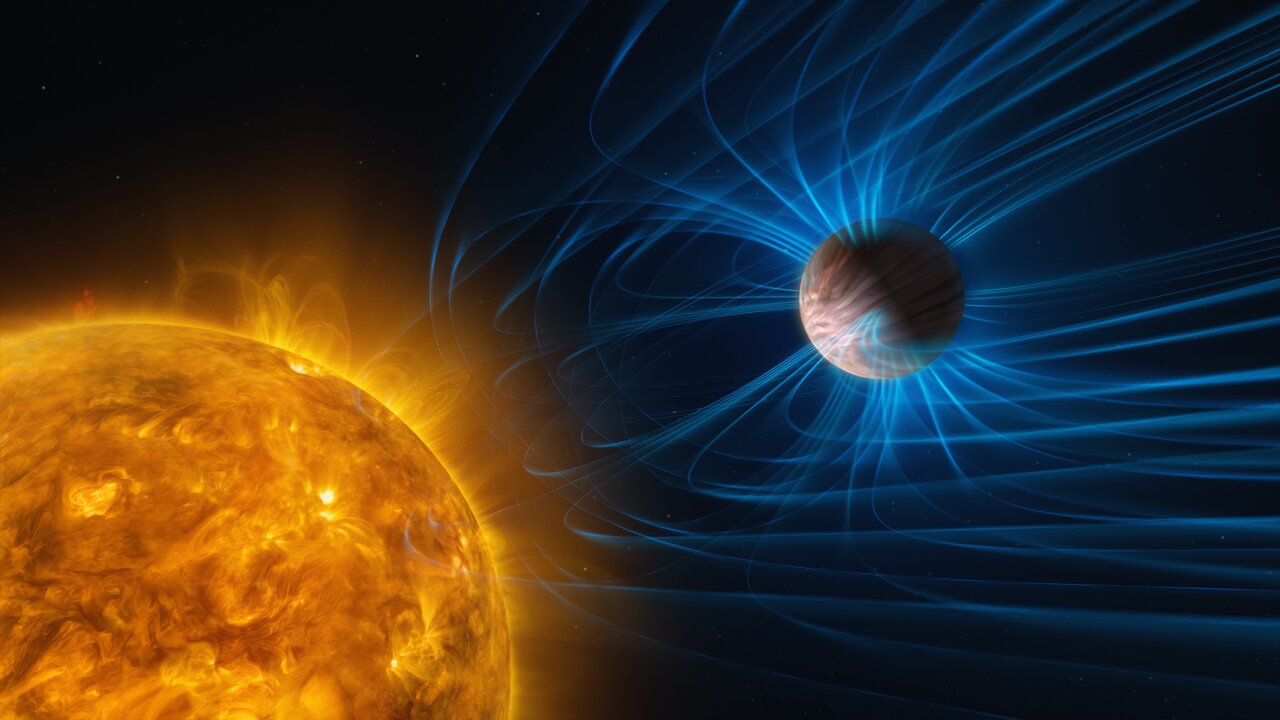
ESO presents the work as the first robust measurement of magnetism on planets orbiting stars other than the Sun. The estimated fields are about four times stronger than Saturn’s and roughly half as strong as Jupiter’s, giving the proposed magnetic strength a scale that can be compared with the gas giants in our own Solar System.
The result combines data from ESPRESSO on ESO’s Very Large Telescope in Chile’s Atacama Desert with observations from a similar instrument on Gemini North in Hawaii. Using both facilities supports the comparison across the seven planets, while the interpretation still applies to the measured sample rather than automatically to every hot Jupiter.
What changes for exoplanet research
The finding adds magnetic fields to the way astronomers interpret weather on intensely irradiated exoplanets. Wind speed is not being presented as a direct view of a magnetic field; the fields are estimated from the atmospheric behaviour observed across the group.
That distinction sets the scope of the result. The seven-planet pattern is more informative than an isolated wind measurement, but ESO’s wording remains careful: these exoplanets could be magnetic, and the proposed fields are an interpretation of the measurements. The immediate advance is therefore a measurable atmospheric signature that extends the study of planetary magnetism beyond the Solar System, not a claim that the magnetic nature of all hot Jupiter-like worlds has been established.