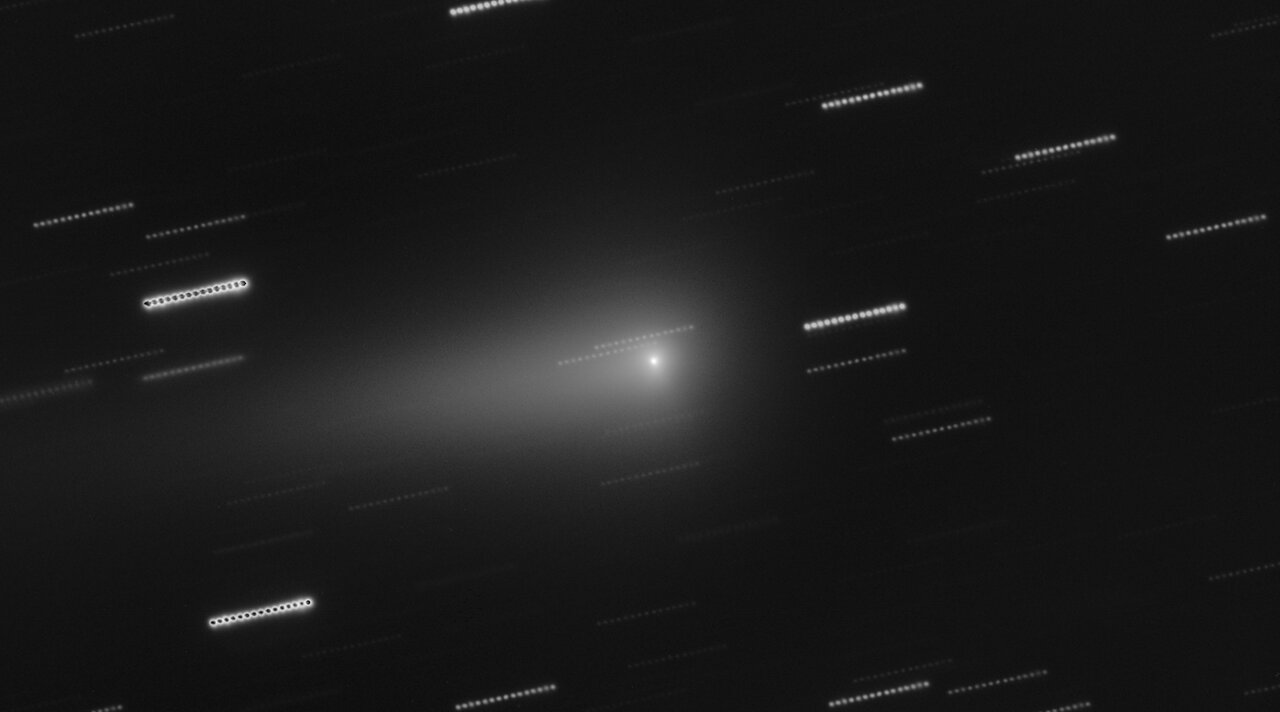
On July 6, 2026, the European Southern Observatory announced that astronomers had studied the composition of 3I/ATLAS in detail with the Very Large Telescope. The object is the brightest interstellar object ever observed, and the ESO announcement describes the result as the first observation of chemical signatures of this kind in a comet formed outside the Solar System.
A chemical signature from beyond the Solar System
The team, led by astronomer Cyrielle Opitom with Jean Manfroid and Damien Hutsemékers, used the UVES instrument installed on the VLT. They measured carbon and nitrogen isotope ratios in cyanide molecules found in the gas surrounding the comet.
Isotopes are different forms of the same element. Their proportions can therefore preserve clues about the environment in which an object formed. In 3I/ATLAS, both ratios are unusually high compared with measurements from comets in the Solar System.
The measurements indicate that the comet probably originated in the outer regions of an ancient stellar system around a star with low metallicity. That points to a formation history unlike the one recorded by comets from our own system, but it does not identify a specific former star system.
Why 3I/ATLAS matters
3I/ATLAS is only the third interstellar object discovered, following 1I/ʻOumuamua and 2I/Borisov. Each of these objects gives astronomers a separate opportunity to compare material formed around another star with the comets known from the Solar System.
The value of this observation is partly its rarity. Astronomers are not examining a typical Solar System comet, but material that formed beyond it and later passed through our planetary neighborhood. The unusually high carbon and nitrogen ratios provide a chemical clue to that distant environment, even though they cannot reveal the comet’s precise birthplace.
Evidence from several studies also suggests that 3I/ATLAS could be more than twice as old as the Sun. That age remains a possibility rather than a direct measurement stated as certain. If it is correct, the object’s history would extend across a much longer timescale than the 4.6-billion-year history associated with the Sun.
The observing window is closing
As 3I/ATLAS moves away from the Sun, it is gradually becoming fainter. Observations with the VLT are therefore approaching their end, reducing the time available for further measurements during this passage through the Solar System.
The European Southern Observatory expects its Extremely Large Telescope to make comparable measurements of future interstellar objects, including visitors less bright than 3I/ATLAS. That does not extend the current observing window, but it could broaden the number of interstellar comets whose chemistry can be studied in detail.
For now, 3I/ATLAS offers an unusually bright target for examining material from beyond the Solar System. Its isotope ratios support a likely origin in an old, metal-poor stellar environment, while the approaching end of VLT observations means that its age and birthplace remain short of complete certainty.