ESO announced Beta Pictoris d on July 15, 2026, adding a third known planet to the Beta Pictoris system. The discovery combines observations from ERIS, an instrument on the European Southern Observatory’s Very Large Telescope, with older images preserved in ESO’s archive. Together, they give astronomers a clearer view of a planetary system 63 light-years from Earth.
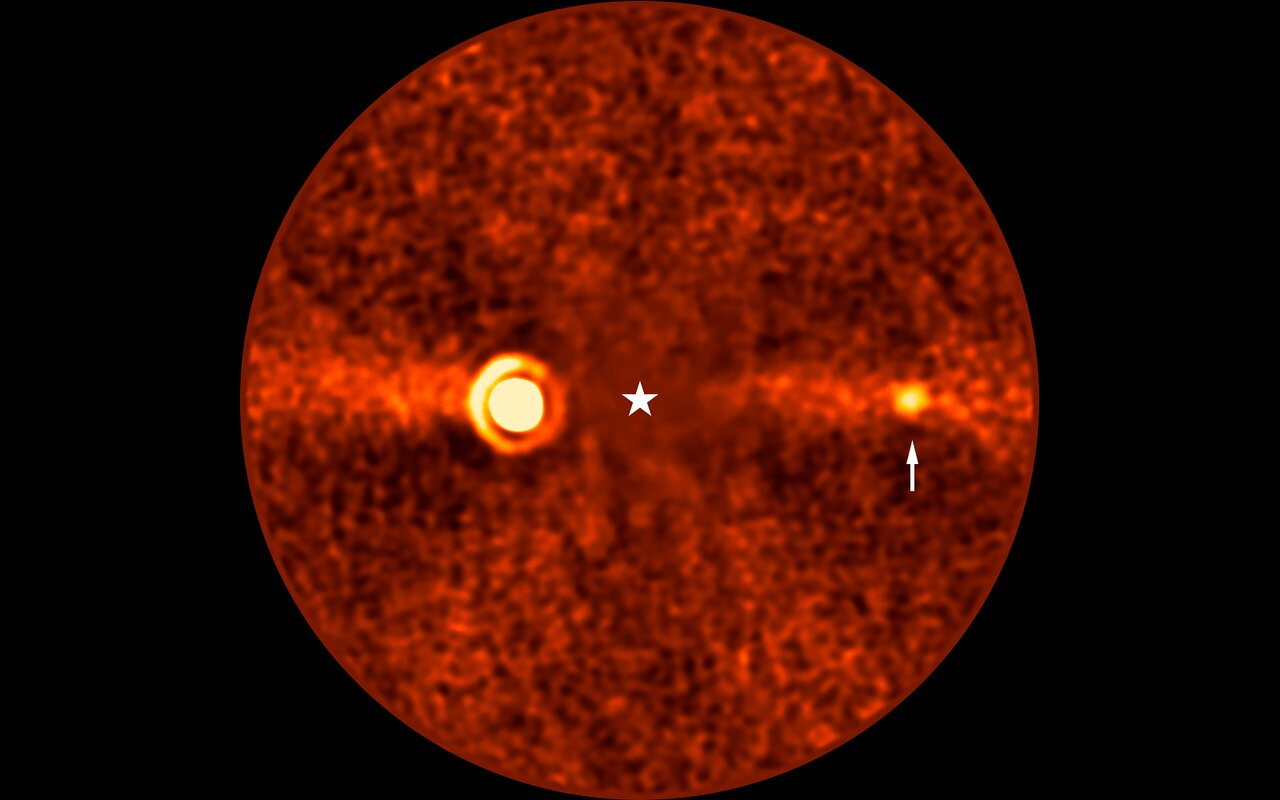
In its July 15 release, ESO identifies ERIS as the source of the first clear detection of Beta Pictoris d. The planet was then recovered in several ESO archival images dating back at least 11 years. One of those images shows it barely visible in the glare of Beta Pictoris b, which helps explain why the object remained difficult to distinguish in earlier observations.
Why the archival images matter
Beta Pictoris d is 100 times less luminous than Beta Pictoris b. That difference makes older observations especially valuable: the planet was already present in the record, but its faint signal could be lost beside the brighter planet and the glare of the star. The discovery therefore rests on more than a single new frame. It links a clear detection with a longer sequence of observations.
Beta Pictoris d is a gas giant, like Beta Pictoris b and c, and is comparable in type to Jupiter or Saturn. Its mass is equivalent to 2.4 times Jupiter’s, far below the roughly 10-Jupiter masses given for both b and c. Its orbit is also much wider than those of the two other planets.
The result adds a system with three directly imaged gas giants whose masses and orbital scales differ markedly. That combination gives astronomers three planets to examine within the same system, rather than a single directly imaged world viewed in isolation.
A rare directly imaged system
An independent team led by Aidan Gibbs at the University of California also discovered Beta Pictoris d using the James Webb Space Telescope. ESO places Beta Pictoris second only to HR 8799 among systems in which more than two exoplanets have been directly imaged.
That ranking makes the announcement relevant beyond the faint object itself. Systems with more than two directly imaged exoplanets remain a small observational group, and Beta Pictoris now joins it with three planets that can be compared by mass, brightness and orbital scale.
The brightness claim needs a precise reading
ESO describes Beta Pictoris d as the least luminous exoplanet ever imaged from Earth only after correcting for distance. The comparison uses absolute magnitude rather than apparent magnitude, so it concerns the planet’s intrinsic brightness ranking rather than how bright it appears in the sky from our location.
For the Beta Pictoris system, the immediate change is straightforward: astronomers now have a third planet to place alongside b and c, identified through new and archival observations. The measured properties establish a faint gas giant with a mass of 2.4 Jupiters and a wider orbit than its two companions. The brightness record still depends on the stated distance correction, but the broader result is clear: long-lived telescope archives can reveal planets that were difficult to separate from stellar glare when the images were first taken.