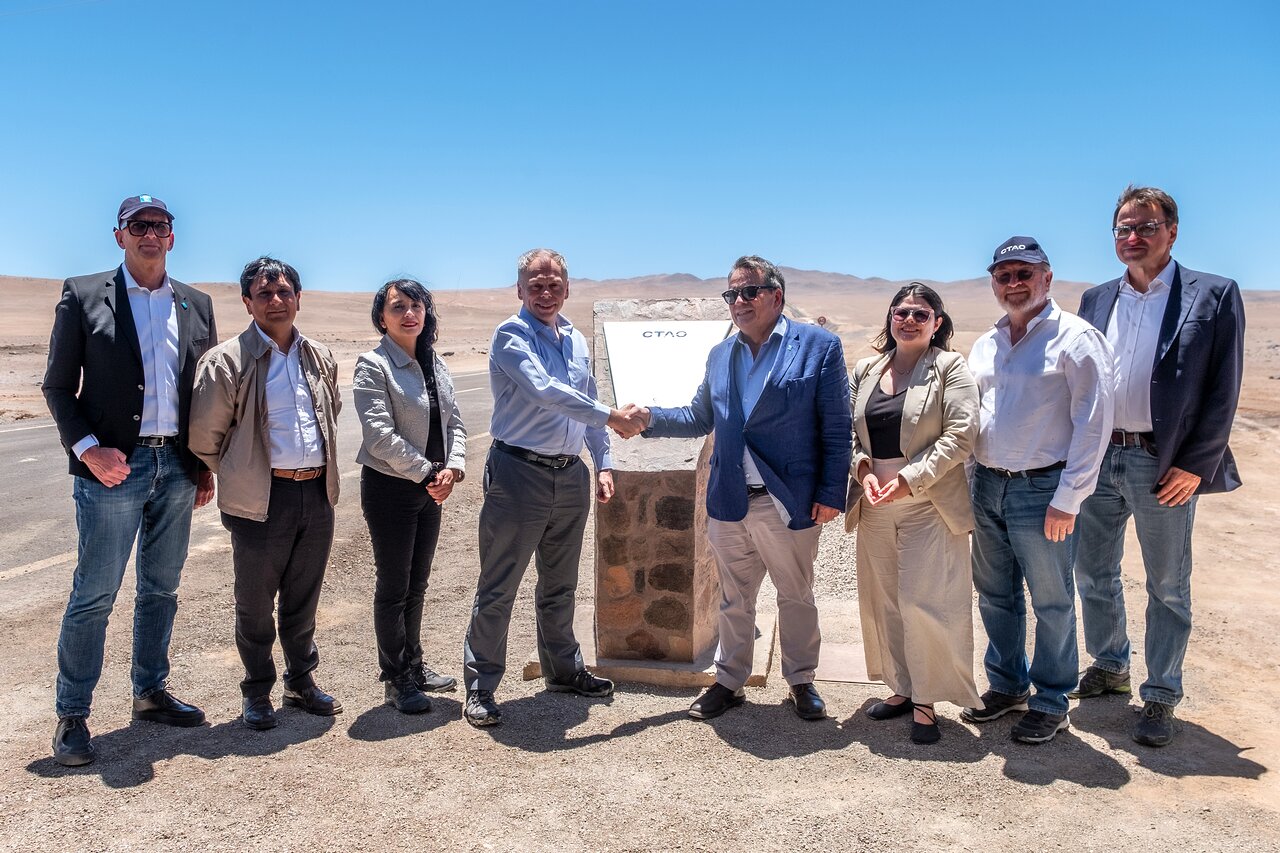
Construction of the CTAO-South gamma-ray array has entered its foundation phase at ESO’s Paranal site in Chile. A ceremony marked the start of the work, according to the European Southern Observatory's announcement dated 18 December 2025.
Chile’s first gamma-ray observatory
The site will host the southern network of the Cherenkov Telescope Array Observatory (CTAO), an international project in which ESO is a founding partner and the host of the southern array. CTAO-South will be the first gamma-ray observatory built in Chile. Its future location is less than ten kilometres southeast of ESO’s Very Large Telescope.
Agreements signed in 2018 between CTAO, ESO and Chilean authorities established Paranal as the home of the southern network. The latest ceremony moves that arrangement into physical construction: the foundations are being built by a consortium of Chilean companies.
A facility designed for extreme-energy signals
ESO describes CTAO as the world’s largest and most powerful gamma-ray observatory. The project is expected to include more than 60 telescopes across CTAO-South and CTAO-North, with one network in each hemisphere. More than 50 telescopes are planned for the southern site, while the full array’s total collecting area will exceed one million square metres.
At Paranal, the southern network is designed to cover energies from 20 GeV to 300 TeV. That range targets gamma rays produced by the most violent and powerful events in the Universe, with radiation billions of times more energetic than visible light.
Why the cameras need to be so fast
CTAO will not observe these gamma rays as ordinary visible-light images. When a gamma-ray photon strikes Earth’s atmosphere, it creates a cascade of particles and a brief blue flash known as Cherenkov light. The flash lasts only a few billionths of a second, so the observatory requires cameras that are both highly sensitive and extremely fast.
The next construction milestone
The start of foundation work is intended to allow the first telescopes to be deployed at Paranal by the end of 2026. That is the next concrete timetable in the announcement. The December ceremony itself is a construction milestone, not a report of new observations or scientific results.
For now, the change is on the ground: CTAO-South has moved from an agreed host site to active foundation construction. If the stated schedule holds, Paranal will begin hosting the first elements of a southern gamma-ray network designed to study some of the highest-energy processes in the Universe.