
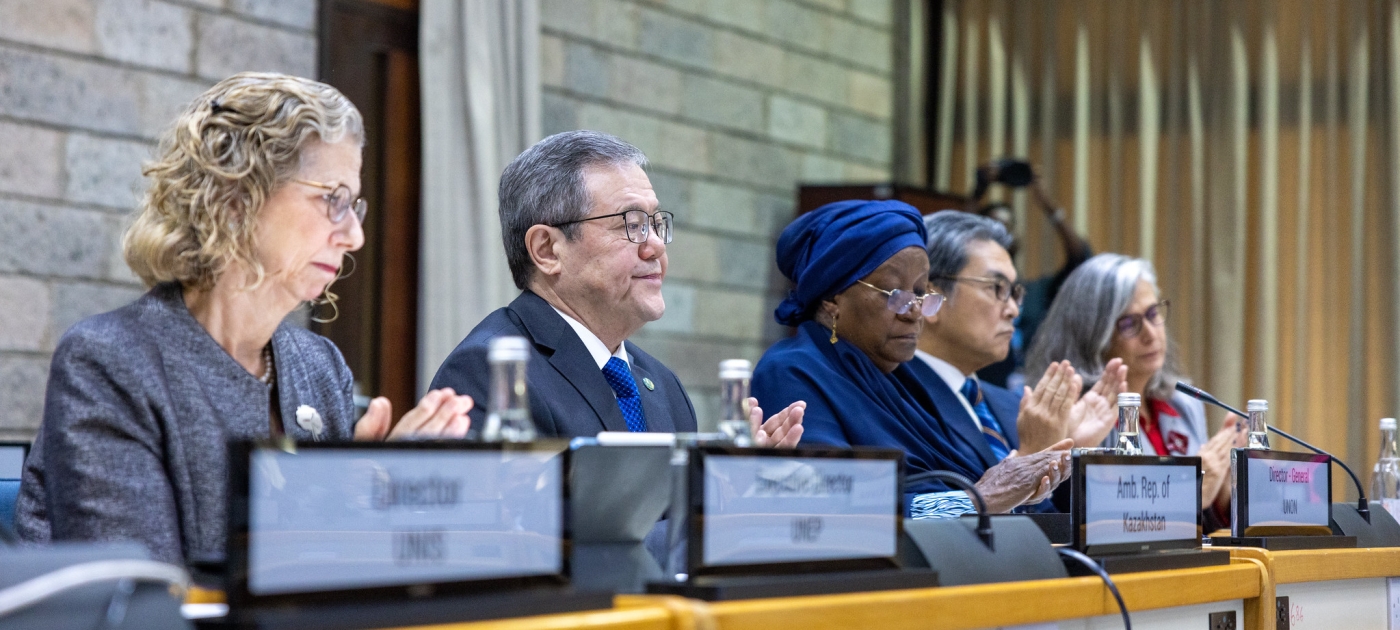
On 2 September 2026, the United Nations Environment Programme listed “An end to nuclear weapons and testing” as a speech on its News, Stories & Speeches page. Delivered by Inger Andersen at an event in Nairobi focused on the humanitarian and ecological consequences of using and testing nuclear weapons, the speech presents nuclear risk as both a public-health issue and an environmental concern.
This review examines the claims recorded in the official UNEP speech and places them alongside the World Health Organization’s account of a public-health resolution approved by member states in 2025. The purpose is to assess what these sources establish, how their evidence is framed, and what they leave as a matter for continued institutional work. It is a desk-based review of official documents, with no product, service or field test involved.
What the UNEP record says
The UNEP speech begins with the historical human cost of nuclear weapons. It states that, by the end of 1945, the bombings of Hiroshima and Nagasaki had caused 140,000 deaths in Hiroshima and 74,000 in Nagasaki. Those figures are presented by UNEP as part of the speech’s account of the consequences of nuclear use, rather than as a new estimate produced for the Nairobi event.
The speech then turns to the legacy of testing. UNEP says that the Semipalatinsk test site hosted more than 450 Soviet nuclear tests between 1949 and 1989. According to the same source, radioactive fallout exposed about 1.5 million residents. UNEP further reports that communities near the former site continue to experience high rates of cancer, cardiovascular disease and intergenerational health problems.
These details give the environmental argument a concrete shape. The issue is not limited to the moment of detonation or to a single location. In UNEP’s account, testing created exposure across affected populations and left health consequences that remain visible around the former site. The speech also warns that nuclear waste from testing could contaminate the environment and threaten marine life and ecosystems if storage bunkers were to fail.
UNEP places those historical and environmental concerns within a broader inventory. It says that more than 2,000 nuclear tests have been conducted by eight countries since 1945. It also states that 9,745 nuclear warheads were recorded worldwide in June, nearly 500 more than in 2018. The speech recommends the Treaty on the Prohibition of Nuclear Weapons as a framework for creating a world without nuclear weapons.
How the WHO account adds a health perspective
The WHO material provides a separate institutional context. On 26 May 2025, WHO member states approved a resolution titled “Effects of Nuclear War on Public Health.” The WHO reports that the resolution recognizes the serious health risks posed by nuclear weapons and describes nuclear war as producing catastrophic immediate and long-term consequences for human health.
The resolution also assigns a continuing role to health institutions. As reported by WHO, it asks the director-general to update reports on the effects of nuclear war on health and health systems, with a report to the World Health Assembly due by 2029. Member states are encouraged to support this work. The resolution recognizes preventing nuclear war as essential to global health, global security and the survival of humanity.
Read together, the two official records describe complementary parts of the same subject. UNEP emphasizes the historical, ecological and intergenerational consequences associated with nuclear use and testing. WHO emphasizes the consequences for human health and health systems, while setting out a process for updating the evidence. Neither source turns the issue into a consumer recommendation or a practical safety guide; both frame it as a matter of international prevention and institutional responsibility.
Review assessment
The UNEP speech is strongest as a concise statement of why nuclear weapons and testing belong within environmental reporting as well as security reporting. Its figures on Hiroshima, Nagasaki, Semipalatinsk, global testing and the June warhead count give the speech a measurable structure. Its warning about storage bunkers extends the discussion from past exposure to a possible environmental pathway that UNEP says could affect marine life and ecosystems.
The WHO resolution adds an important measure of continuity. It does not merely describe nuclear war as a historical danger; the WHO account says the resolution asks for updated reporting on health and health systems through 2029. That future reporting requirement matters because it identifies prevention and preparedness as ongoing public-health work, while the UNEP speech supplies the environmental and historical context for why that work remains urgent.
This review does not independently verify the figures beyond the cited UNEP and WHO records, and it does not claim to measure current health conditions, contamination levels or the probability of storage failure. Its conclusion is therefore limited to the documentary record supplied by the two institutions. Within that scope, the evidence supports a clear finding: the official sources treat nuclear weapons and testing as a continuing humanitarian, environmental and public-health issue, not as a closed historical episode.
Verdict: The dossier supports publication as verified general-news reporting. The subject fits a science, space and environment editorial scope through its focus on environmental contamination, ecosystems and public health. The reporting is appropriately framed as a source-based review, with the limits of that method stated openly.
Official sources
Test protocol
Verdict
The official records support verified general-news reporting that presents nuclear weapons and testing as continuing humanitarian, environmental and public-health concerns, while clearly stating that this is a source review rather than an independent measurement or hands-on test.
No manufacturer reviewed or approved this assessment.