
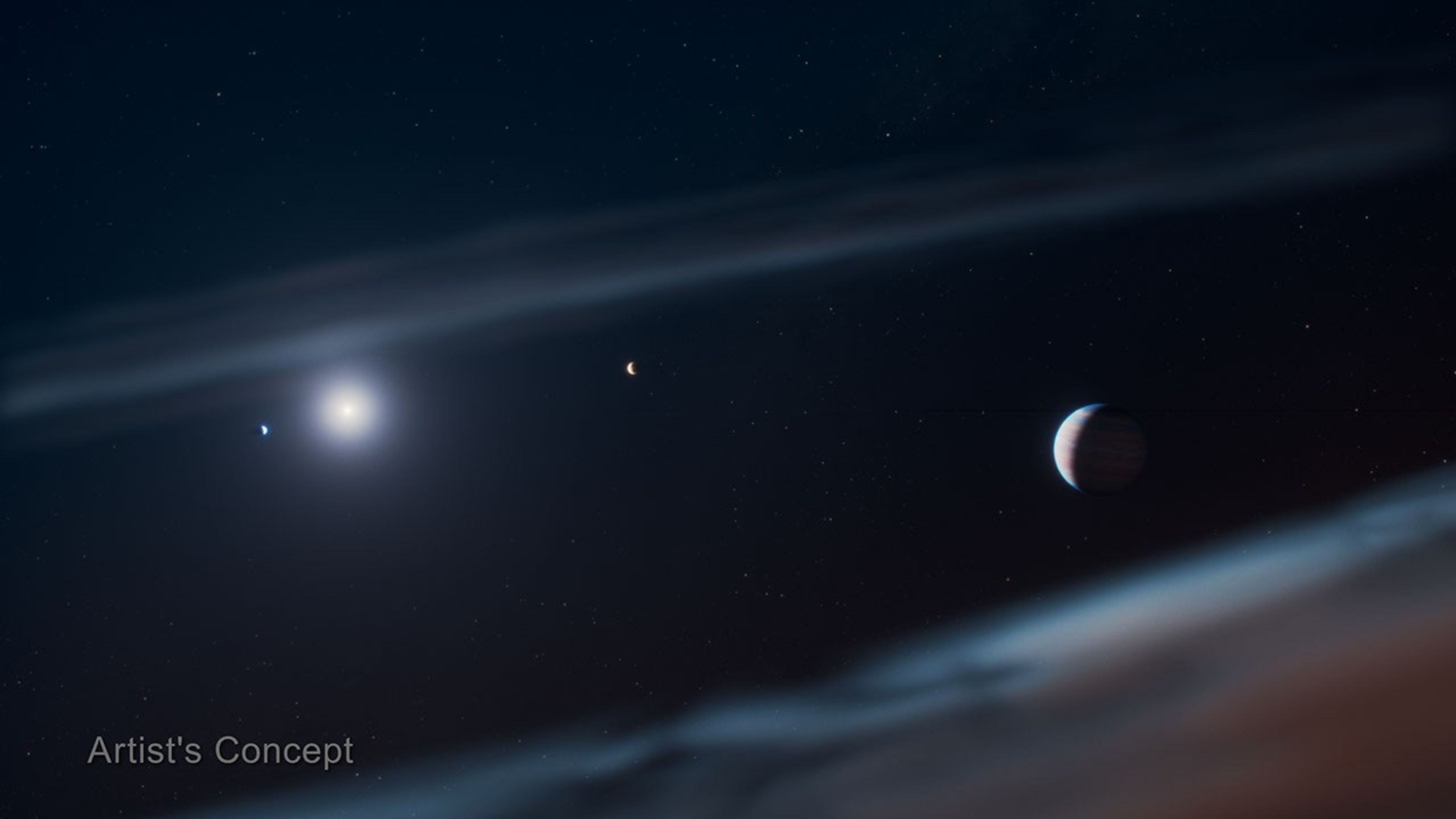
NASA’s James Webb Space Telescope has revealed a hidden member of one of the most closely watched planetary systems near the Sun. In a recent NASA announcement, astronomers describe the discovery of Beta Pictoris d, a giant exoplanet whose presence emerged not from a bright point of light, but from the chemical signature of its atmosphere.
The result expands the Beta Pictoris system to three known directly imaged planets. It is only the second planetary system known to contain at least three planets imaged around the same star, making it an unusually valuable laboratory for studying how young planetary systems form and evolve.
A young system with a new surprise
Beta Pictoris is about 63 light-years from Earth and roughly 23 million years old. That makes it young by astronomical standards, and its surrounding debris disk preserves material left over from the system’s formation. The star was already known to host Beta Pictoris b and Beta Pictoris c, two large planets that helped make the system a reference point for research into giant planets and dusty planetary environments.
NASA’s team estimates that Beta Pictoris d has at least twice the mass of Jupiter. Models indicate that it follows an orbit of about 30 astronomical units, comparable to the region occupied by Neptune in our own solar system. It is the widest-orbiting member of the three known planets, while still remaining inside the inner edge of the system’s debris disk.
That location helps explain why the planet was difficult to see. Beta Pictoris is surrounded by one of the brightest debris disks known, and dust scattered from the disk can make it difficult to distinguish a faint planet from background structures and instrumental artifacts.
Finding a planet through its atmosphere
The discovery happened while researchers were using Webb’s Near-Infrared Spectrograph, or NIRSpec, to study the atmosphere of Beta Pictoris b. Its Integral Field Unit records an image and a spectrum for every pixel, allowing scientists to examine both where light comes from and what that light contains.
An unexpected source appeared in the data. Rather than treating the bright signal as proof of a planet, the team looked for a chemical explanation. The spectrum contained a distinctive pattern of carbon monoxide absorption lines, resembling a molecular barcode expected in the atmosphere of a giant planet.
The same observations also supplied information about motion. The measured radial velocity, position, and alignment with the debris disk were consistent with an object orbiting Beta Pictoris, rather than a distant background star or a brown dwarf. Follow-up observations with Webb’s Mid-Infrared Instrument detected water vapor and methane, providing additional evidence that the source was a planet and offering an early view of its atmosphere.
A separate imaging study using the European Southern Observatory’s Very Large Telescope and Webb’s Near-Infrared Camera independently confirmed the existence of Beta Pictoris d. Together, the observations show why spectroscopy can be decisive when ordinary images are crowded by dust.
Why the discovery matters
Direct imaging usually depends on separating a planet’s faint glow from the much brighter light of its host star and from surrounding material. In this case, the atmospheric fingerprint provided the crucial clue. NASA describes the result as the first directly imaged planet discovered primarily through moderate-resolution spectroscopy.
The technique changes the order of discovery. Instead of first identifying a clean planetary point and then studying its atmosphere, astronomers can use atmospheric chemistry to confirm a candidate that is difficult to isolate visually. That approach could be particularly useful in young systems, where bright debris disks contain clues about planet formation but also make conventional imaging more complicated.
Beta Pictoris d is still only partly characterized. The team plans further analysis to refine its temperature, atmospheric composition, and orbit. Those measurements will help scientists compare all three giant planets in the system and test how their positions relate to the disk’s sharp inner edge and other structures.
The discovery does not turn Beta Pictoris d into an Earth analogue. It is a massive gas giant orbiting far from its star in a young, dusty system. Its importance lies elsewhere: it gives researchers a new opportunity to watch planetary architecture taking shape and demonstrates how the chemistry of an atmosphere can reveal a world hidden in cosmic fog.
As Webb continues its work as a premier space observatory, discoveries like this show the value of combining imaging, spectroscopy, and follow-up observations. The full significance of Beta Pictoris d will depend on the measurements still to come, but its first detection already points toward a more chemically informed way to find and study planets beyond the solar system.