
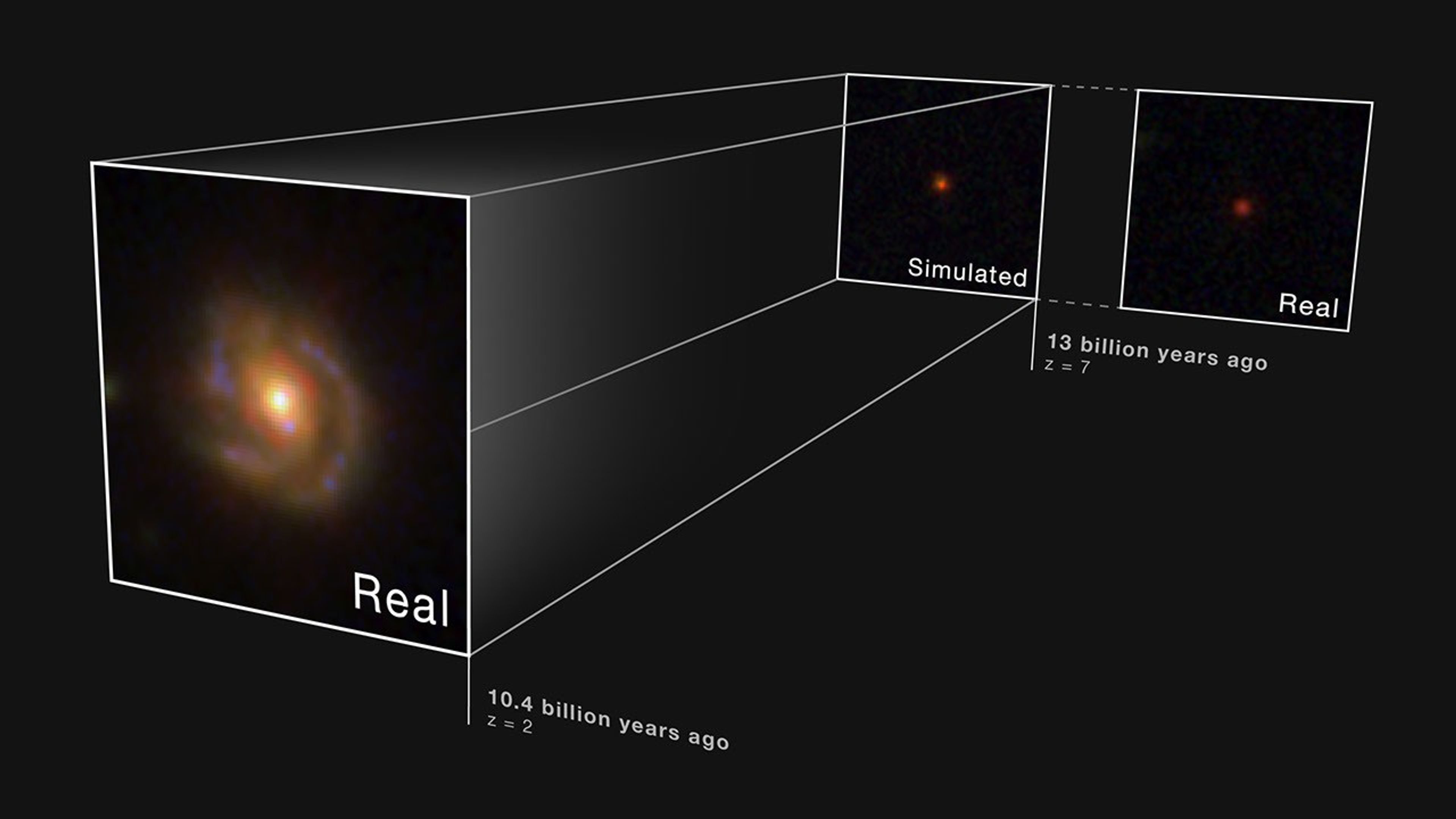
NASA’s James Webb Space Telescope has helped give astronomers a more complete way to think about one of the early universe’s most puzzling populations. A new analysis of a distant spiral galaxy suggests that the compact sources known as “little red dots” may be a temporary phase in the growth of highly active supermassive black holes, rather than a separate class of galaxy that simply vanished as the cosmos aged.
The result, reported by NASA Science, does not close the case. The underlying study, published in The Astrophysical Journal, offers a plausible route between the numerous little red dots seen at high redshift and the active galactic nuclei that astronomers observe in the more mature universe. The distinction matters: the study examines one particularly useful galaxy, and the researchers explicitly say it is not representative of every little red dot.
A mysterious population in the young universe
Webb first brought little red dots, or LRDs, to wide attention in 2022. They are extremely distant, compact red sources that appear abundant when the universe was young, yet become much less common at lower redshifts. In practical terms, a higher redshift means that light has travelled farther and for longer before reaching Earth. The apparent change in population has left astronomers with a straightforward but difficult question: what do these objects become as the universe matures?
One leading interpretation has been that LRDs are active galactic nuclei, the bright centres of galaxies powered by material falling toward supermassive black holes. But the distant sources do not look exactly like nearby examples. Their compact appearance, unusual colours and generally weak X-ray signal have made it difficult to connect the two populations with confidence.
The Saguaro provides a closer look
The new study focuses on a lower-redshift spiral galaxy formally identified as WISEA J123635.56+621424.2 and nicknamed the “Saguaro” because of its prominent arms. Its light comes from a period roughly 3.3 billion years after the Big Bang, late enough for the surrounding galaxy to be seen in detail but still early enough to offer a useful comparison with the distant LRD population.
Researchers led by Pierluigi Rinaldi combined archival observations from Webb and NASA’s Hubble Space Telescope across different wavelengths. The Saguaro’s central source is compact and red, but its host galaxy is visible around it. The nucleus is brighter in ultraviolet and infrared light than in visible light, a pattern that resembles the distant little red dots. NASA’s Chandra X-ray Observatory also detected weak X-ray emission, consistent with an active galactic nucleus that is both heavily obscured and unusually faint in X-rays.
That combination gives astronomers a way to study the surroundings that cannot normally be resolved around the farthest LRDs. It also helps explain why the early sources can appear almost isolated: their host galaxies may be present, but their light is too faint to separate from the compact red centre at extreme distances.
Testing what Webb would have seen
The team then carried out a deliberately simple but revealing test. They synthetically shifted the Saguaro to a much higher redshift, asking how the same galaxy would look if it were observed much earlier in cosmic history. As the simulated distance increased, the spiral structure faded while the bright compact centre remained visible. The result looked like a little red dot.
This exercise does not mean the Saguaro was literally transported through time, nor does it prove that every LRD has the same history. Its value is observational: it shows how limited resolution and surface brightness can hide a galaxy’s environment. What looks like a new, self-contained population may partly reflect what current telescopes can and cannot see around a very bright nucleus.
A possible stage in black-hole growth
From the Saguaro case, the researchers propose that many little red dots could be a short-lived phase of highly active supermassive black holes interacting with their nearby surroundings. In that picture, the red compact source is not the whole galaxy. It is the visible tip of a more complex system whose host becomes easier to recognise as the universe evolves and the source is observed at lower redshift.
The “family tree” in the study’s title is therefore a metaphor for a sequence of observable stages, not a claim that one named object has been followed from the early universe to the present. The proposed link would help reconcile the high number of LRDs seen by Webb with the active galactic nuclei found in later cosmic epochs.
What remains to be tested
The researchers say the Saguaro is an important case study, but more examples are needed. The next steps include finding additional Saguaro-like galaxies at lower redshift and searching Webb’s extensive archive for more little red dots whose host environments can be studied. Larger samples will be needed to determine how common this pathway is and whether other physical processes can produce the same compact red appearance.
For now, Webb’s contribution is less about naming a final answer than about improving the question. By combining infrared sensitivity with Hubble’s complementary view and X-ray evidence from Chandra, astronomers can begin to separate the real evolution of galaxies from the observational effects created by distance. The mysterious red points may be less like isolated cosmic oddities and more like brief, energetic chapters in the life of growing galaxies.