NASA’s James Webb Space Telescope is helping astronomers test a more nuanced explanation for the universe’s “little red dots”: they may not be a separate kind of galaxy, but a temporary stage in the growth of highly active supermassive black holes.
That interpretation comes from a study summarized in NASA Science’s report on Webb’s latest analysis. Led by Pierluigi Rinaldi, the team examined a lower-redshift spiral galaxy called WISEA J123635.56+621424.2, nicknamed the “Saguaro” because of its prominent arms. Its compact, red centre resembles the distant objects that Webb has found in the early universe.
A nearby look at a distant puzzle
Little red dots, or LRDs, were first identified with Webb in 2022. They appear as compact red sources at high redshift, meaning their light has travelled across much of cosmic history before reaching Earth. Many seem to have been common when the universe was young, yet they become far less frequent at lower redshifts. Their unusual colours, compact appearance and apparent connection to supermassive black holes have made them difficult to classify.
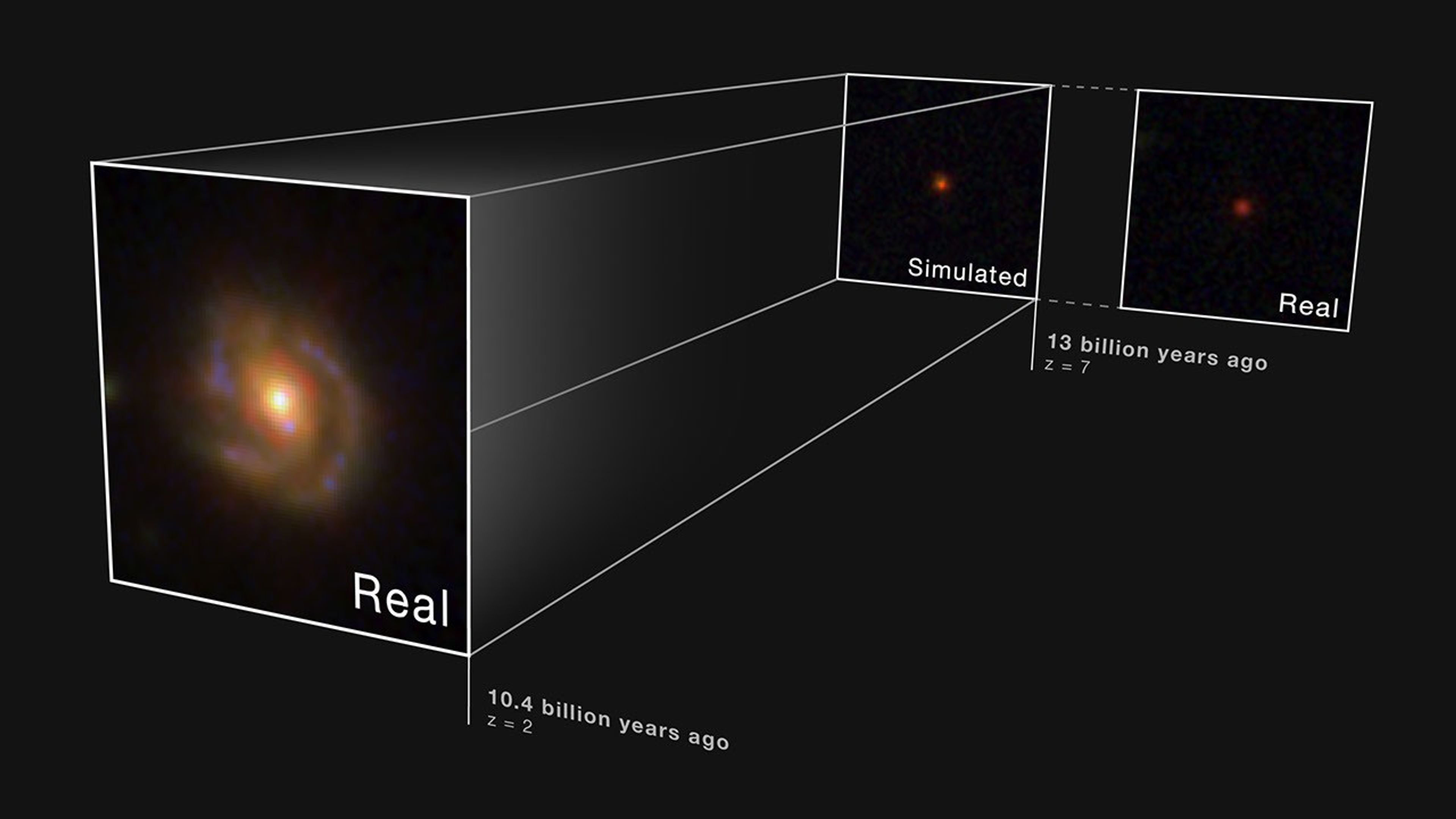
The Saguaro offers a valuable comparison because it is observed at redshift 2, corresponding to roughly 3.3 billion years after the Big Bang. Unlike the distant LRDs, its host galaxy can be seen in detail. The researchers combined ultraviolet observations from the Hubble Space Telescope with Webb’s infrared imaging and spectroscopy to separate the light from the spiral galaxy and its compact central source.
The central source is brighter in ultraviolet and infrared light than in visible wavelengths, matching several characteristics associated with little red dots. NASA’s report also notes weak X-ray emission detected by the Chandra X-ray Observatory. That signal is consistent with an active galactic nucleus: a supermassive black hole accreting material while partly hidden by surrounding dust.
How observing bias enters
The team then performed a virtual experiment. They synthetically shifted the Saguaro to a much higher redshift to estimate how the same galaxy would appear in the early universe. As expected, its surrounding structure became too faint to distinguish, while the bright compact centre remained visible. To a distant observer, the entire system could therefore look like a single little red dot.
This is an example of observational bias. The telescope is not necessarily seeing a completely different kind of object; it may simply be unable to detect the faint environment around a bright nucleus. At lower redshift, where more light and detail are available, the surrounding spiral structure becomes visible again.
That result supports the idea that at least some LRDs could be a temporary phase of highly active supermassive black holes rather than a permanent galaxy category. A distant galaxy in a rapid-growth phase could appear as a red compact source, while a closer or older version of the same broad process might look like a normal galaxy with an obscured active nucleus.
The finding does not establish that every little red dot follows the same path. NASA’s account stresses that the Saguaro is not representative of the entire LRD population. It is a particularly useful case study, but a single example cannot settle the identity or evolution of all these sources.
Why the result matters
The significance is less about renaming a class of galaxies than about improving how astronomers interpret Webb’s deep surveys. If many LRDs are short-lived stages of black-hole growth, their abundance in the early universe may reflect how many galaxies passed through an intense active phase, rather than how many belonged to a stable population that later disappeared.
That possibility could help connect Webb’s observations of the young universe with the supermassive black holes found in mature galaxies today. It may also explain why the distant sources look unusually simple: at extreme distances, the bright central engine remains visible while the host galaxy falls below the sensitivity and resolution of current observations.
Still, the study offers a possible route, not a complete evolutionary timeline. It does not determine how long the little-red-dot phase lasts, how frequently it occurs, or whether all such objects are powered in the same way. Those questions require a larger sample and observations of more galaxies that resemble the Saguaro.
What researchers will test next
The team plans to search Webb’s extensive archive for additional Saguaro-like galaxies at lower redshift and to study how their compact central sources relate to their hosts. Finding more examples would allow astronomers to compare the brightness, dust content, surroundings and activity of these systems instead of relying on one unusually informative galaxy.
For readers, the important distinction is between an image and a conclusion. Webb did not watch one galaxy evolve across billions of years. Instead, researchers compared a nearby analogue with a simulated high-redshift view and used data from several observatories to test whether it matches the observed properties of little red dots. The result is a clear, testable explanation for a cosmic mystery—one that future observations can confirm, refine or reject.