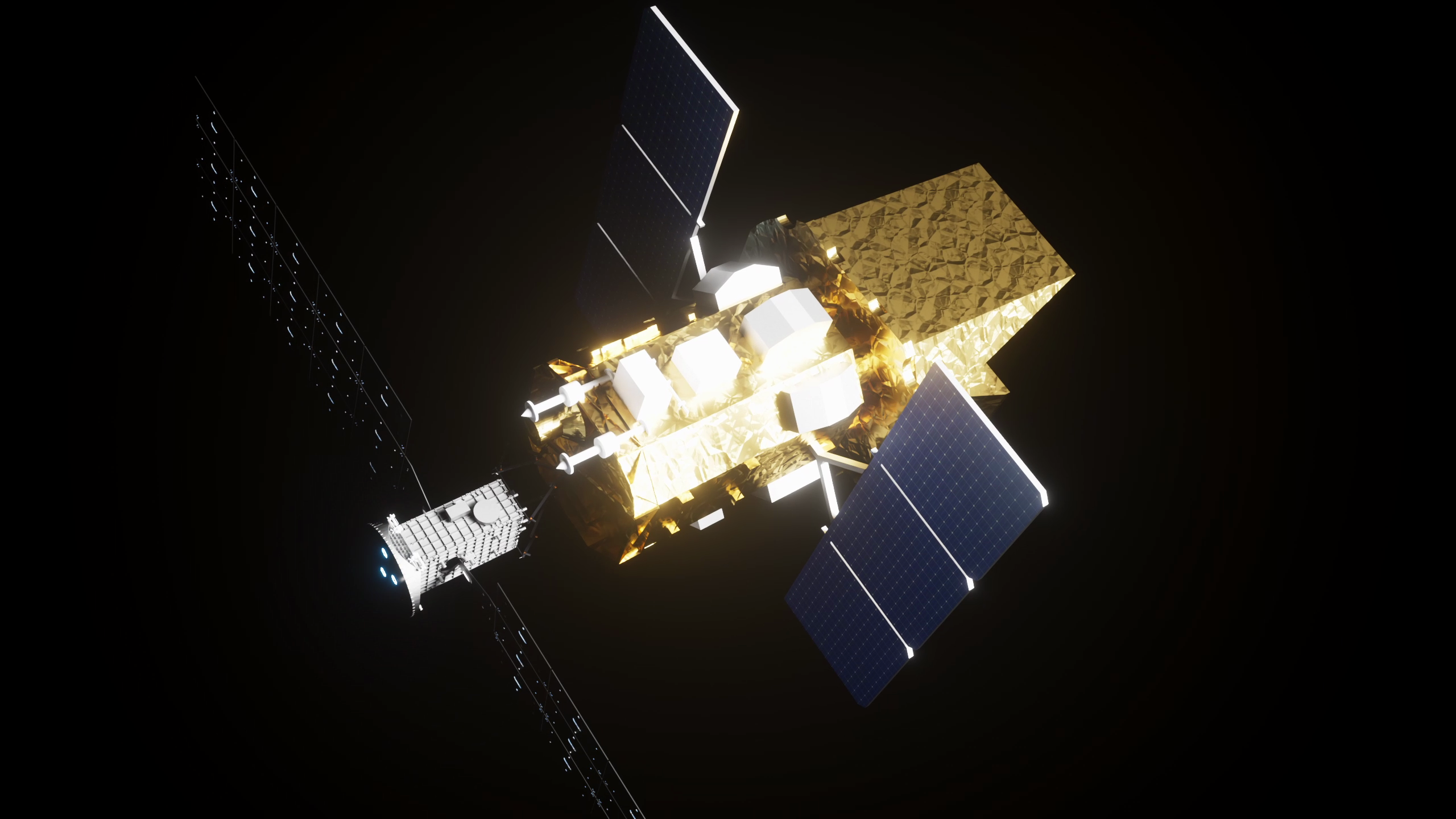
NASA's Neil Gehrels Swift Observatory is heading into a delicate phase of an unusual orbital-maintenance effort. In its Aug. 11 update, NASA said Katalyst Space had successfully uploaded new flight software to the LINK spacecraft, the vehicle intended to raise Swift into a higher orbit.
The update is important, but it is not a declaration that Swift has already been captured or moved. The software is designed to help LINK maintain its attitude using the spacecraft's remaining actuators. With that control milestone in place, the team can continue the approach toward Swift and evaluate the spacecraft at each stage before attempting the rendezvous and orbit-raising maneuvers.
A software milestone, not a completed rescue
LINK's job is unusually demanding. It must first remain stable, then align its orbit with Swift closely enough for the next phase of the operation. NASA says Katalyst will carry out a series of burns and maneuvers in the coming days to bring the two spacecraft together. Each burn changes the orbit only slightly, so the team needs reliable attitude control and repeated checks before committing to the next step.
That distinction matters because the latest announcement describes preparation, not an outcome. A successful software upload improves LINK's ability to point and maneuver, but it does not by itself prove that the spacecraft can complete the approach, make contact, or safely raise Swift. NASA's wording leaves those milestones ahead, with performance to be evaluated as the sequence unfolds.
The operation is driven by orbital drag. Swift is currently at an altitude of about 216 miles, or 347 kilometers, according to NASA. Earth's upper atmosphere is extremely thin at that height, but it is not empty: the residual drag gradually removes orbital energy. NASA has said that an orbit-raising maneuver becomes more difficult once Swift falls below an average altitude of about 185 miles, or 300 kilometers. The boost effort therefore aims to create more room for the observatory's continued work.
Why Swift still matters
Swift is not a retired satellite waiting to be displayed in a museum. NASA's mission page describes an active space observatory launched on Nov. 20, 2004. It carries three telescopes that observe visible, ultraviolet, X-ray, and gamma-ray light, giving researchers a rapid, multiwavelength view of gamma-ray bursts and other violent events across the universe.
Gamma-ray bursts are brief and unpredictable, so the ability to react quickly is central to Swift's scientific value. The observatory can detect a burst, locate it, and provide follow-up observations in different wavelengths. Those measurements help astronomers study the deaths of massive stars, the mergers of compact objects, and the extreme environments around energetic cosmic sources. Keeping the spacecraft in a workable orbit preserves access to an instrument designed for exactly that kind of time-sensitive astronomy.
Swift's age also makes the boost attempt notable. The observatory has spent more than two decades in low Earth orbit, while the new operation depends on a separate spacecraft approaching it. NASA's update presents the effort as a carefully staged engineering campaign rather than a routine orbit correction. It combines software changes on LINK, orbital maneuvers, and a planned capture of an observatory that was not built as a target for this kind of servicing mission.
What comes next
For now, the meaningful milestone is that LINK has regained the control capability needed to continue its approach. The next evidence will come from the mission team's reports on the spacecraft's performance during its burns and alignment maneuvers. If those steps proceed as planned, the team will then face the more difficult task of capturing Swift and raising its orbit. NASA has not announced a completed capture or a final new orbit in the update covered here.
That measured sequence is useful for readers following the mission. Headlines about a “rescue” can easily imply that the operation is finished, when the available evidence shows a campaign still in progress. The safest summary is narrower: NASA and Katalyst have cleared a software milestone, and LINK is preparing to continue the approach to Swift.
The effort also gives the public a close view of how orbital operations work in practice. Spacecraft do not simply remain fixed above Earth; they need power, pointing control, communications, and enough orbital altitude to keep atmospheric drag from winning. Swift's science may concern the most distant explosions in the universe, but its immediate future depends on precise, local decisions made in the thin edge of Earth's atmosphere.