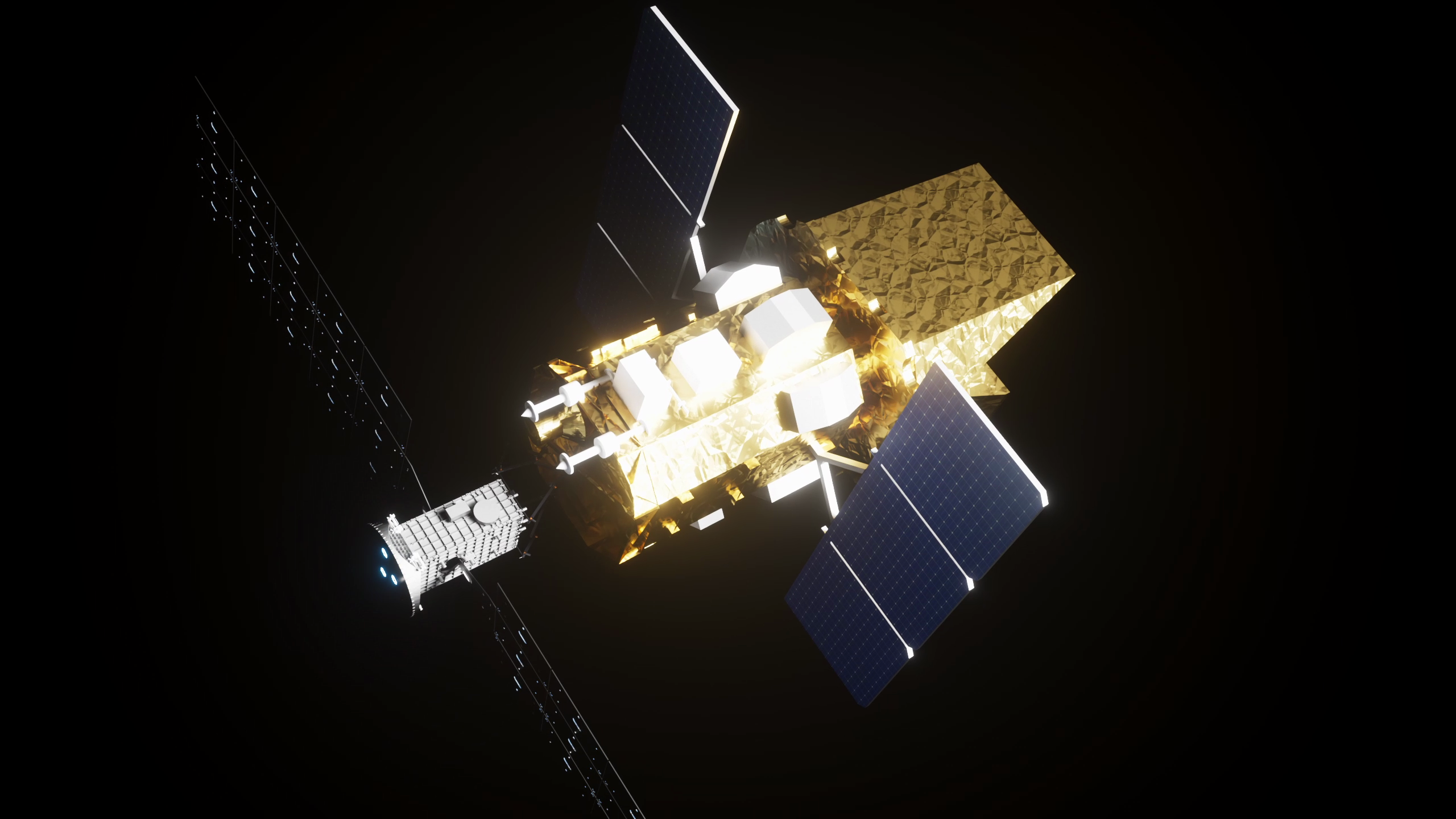
NASA’s plan to extend the life of the Neil Gehrels Swift Observatory has entered a new operational phase. Katalyst Space has successfully uploaded a flight-software update to its LINK spacecraft, which is designed to rendezvous with Swift, capture it, and raise it into a higher orbit. The update is described in NASA’s latest mission report as an important step in preparing LINK for that approach.
The milestone is not a completed rescue. LINK has not yet captured Swift, and the spacecraft still has to complete a sequence of orbital manoeuvres before an attempted docking. NASA says the new software is intended to help LINK maintain stability using the spacecraft’s remaining actuators. Teams will continue evaluating its performance at each stage while planning a series of burns and manoeuvres to align LINK’s orbit with Swift.
Why Swift needs an orbital boost
Swift has spent more than two decades observing some of the most violent and rapidly changing events in the universe. The NASA mission overview describes it as a multiwavelength space observatory, with telescopes that collect visible, ultraviolet, X-ray, and gamma-ray light. That combination allows Swift to respond to transient events such as gamma-ray bursts while also studying active galaxies, stellar flares, novae, and other changing objects.
Its low-Earth orbit is now becoming increasingly difficult to maintain. NASA’s update places Swift at an altitude of about 216 miles, or 347 kilometres. Atmospheric drag is gradually reducing that altitude. The agency says an orbit-raising manoeuvre would become more difficult once Swift falls below an average altitude of about 185 miles, or 300 kilometres. The boost effort is therefore designed to create more operating room before the observatory’s natural orbital decay becomes a greater threat.
How the recovery sequence is expected to work
LINK is a robotic servicing spacecraft developed for the boost mission. According to NASA’s official Swift Boost Mission page, the vehicle must first complete its approach and rendezvous operations. It can then attempt to capture Swift and raise the observatory’s orbit over the following phases of the mission.
The latest software update focuses on control rather than propulsion. Its attitude-control algorithms are intended to keep LINK properly oriented while the spacecraft uses the actuators still available to it. That stability matters during a complex approach, when small navigation or pointing errors can affect the timing of later manoeuvres. NASA says Katalyst and mission teams will assess LINK’s behaviour as the spacecraft continues toward Swift, rather than treating the software upload as proof that the full operation is assured.
The next visible milestones should therefore be incremental: orbital alignment, additional burns, continued approach, and eventually an attempt to establish contact with Swift. NASA’s Swift Boost media resources explain that the operation is expected to unfold over several months. The agency’s current update does not announce a completed capture or a final boosted orbit.
What is at stake for astronomy
Swift’s value comes from the speed and breadth of its observations. Gamma-ray bursts can fade quickly, and other high-energy events evolve on timescales that make rapid follow-up important. A spacecraft that can observe across several wavelengths gives researchers more than a single view of an explosion or flare: it helps connect the event’s high-energy emission with its ultraviolet, optical, and X-ray behaviour.
Keeping Swift in a safer orbit would preserve that capability without replacing the observatory’s instruments. It would also protect a long-running scientific archive built from observations since the spacecraft’s launch in 2004. The boost mission is therefore a maintenance operation with scientific consequences: its success would help keep an established observatory available for future alerts and time-sensitive investigations.
A cautious next step
For now, the software update gives mission controllers another tool for the most demanding part of the operation. The teams still have to validate LINK’s performance, refine its trajectory, and attempt the capture under carefully managed conditions. NASA’s wording keeps the distinction clear: the spacecraft is prepared to continue its approach, while the orbit-raising manoeuvre remains ahead.
That makes the next reports especially important. A successful approach would confirm that LINK can hold the required attitude and trajectory. A completed capture would mark the beginning of the physical boost itself. Until NASA reports those events, Swift’s future orbit remains an objective rather than a result.