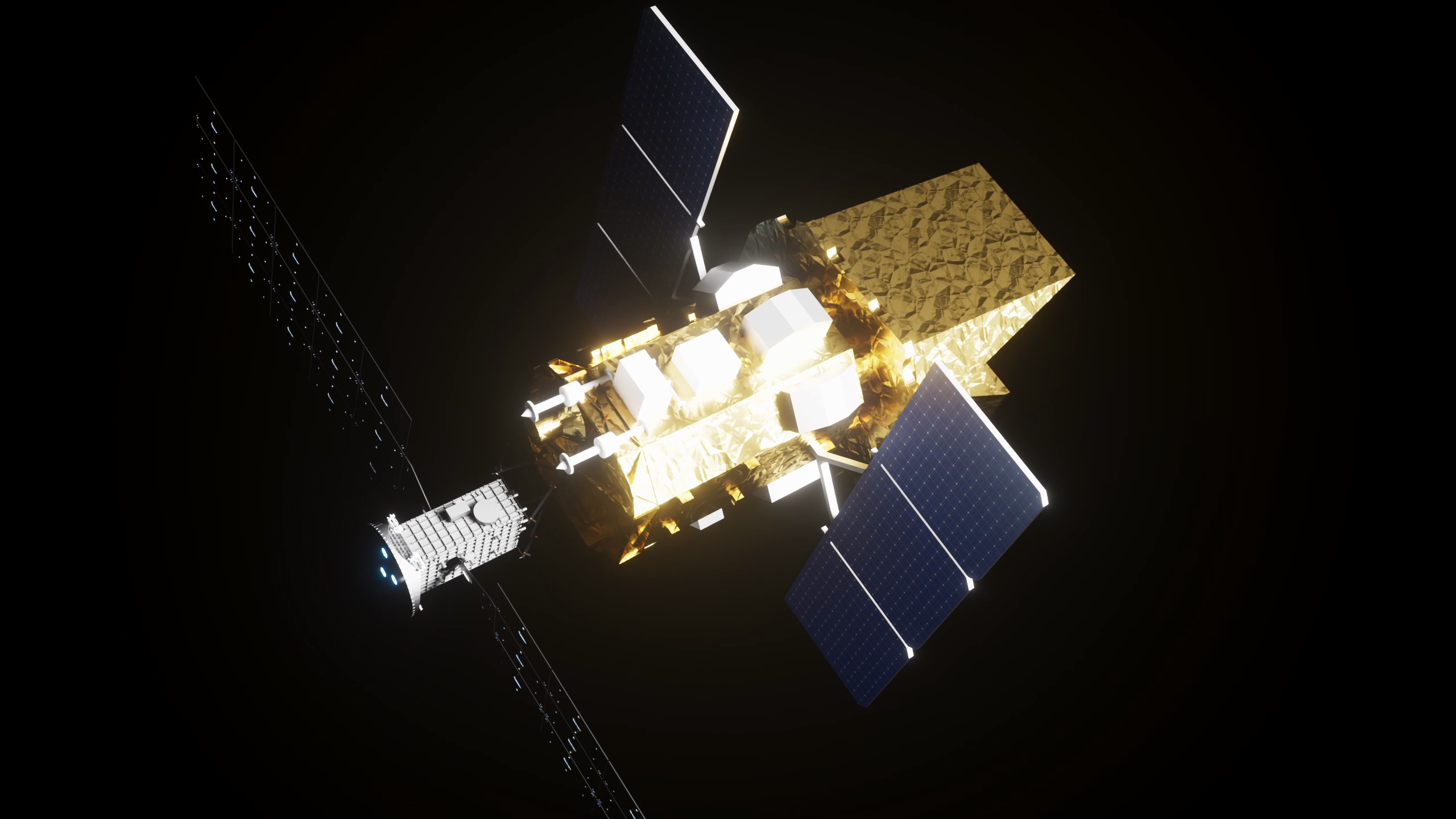
NASA’s plan to extend the life of the Neil Gehrels Swift Observatory has reached another important checkpoint. Katalyst Space has successfully uploaded a flight-software update to LINK, the robotic spacecraft designed to capture Swift and raise it to a higher orbit.
According to NASA’s latest mission update, the new software includes attitude-control algorithms intended to keep LINK stable using the spacecraft’s remaining actuators. The change allows the team to resume preparations for the next phase of the mission while continuing to evaluate LINK’s performance.
A software update for a demanding rendezvous
LINK must eventually approach Swift, align its orbit, capture the observatory, and then raise it to a higher altitude. That sequence requires careful control of the servicing spacecraft’s orientation, propulsion, navigation, and timing. NASA says the team will assess LINK at each stage as it performs a series of burns and orbital manoeuvres in the coming days to align its path with Swift.
The update does not mean that capture has already happened, nor does it establish a final date for the rendezvous. It is a step that keeps the mission moving toward the approach and capture attempt. The operation remains dependent on the spacecraft’s health and on the results of each manoeuvre.
Why Swift needs a boost
Swift has spent more than two decades in low Earth orbit studying some of the universe’s most energetic and rapidly changing events. The observatory can observe targets in visible, ultraviolet, X-ray, and gamma-ray light, making it particularly useful for following transient phenomena such as gamma-ray bursts.
Like every spacecraft in low Earth orbit, Swift is affected by atmospheric drag. The drag becomes stronger when solar activity heats and expands the upper atmosphere. NASA’s Swift Boost Mission overview explains that a recent period of increased solar activity accelerated the observatory’s orbital decay.
To preserve the opportunity for a reboost, Swift’s operations team changed how the observatory is oriented and operated. Those changes have reduced drag and slowed the spacecraft’s descent. NASA reported on Aug. 11 that Swift was orbiting at about 216 miles, or 347 kilometres, above Earth. The agency says an orbit-raising manoeuvre would become more difficult once the observatory’s average altitude fell below about 185 miles, or 300 kilometres.
A commercial servicing demonstration
The mission is also a test of a broader idea: using a privately built robotic vehicle to extend the useful life of an existing scientific spacecraft. Swift was not originally designed to be serviced in orbit, so LINK’s approach must be planned around the observatory’s existing structure, operating constraints, and orbital trajectory.
NASA awarded Katalyst Space a contract for the boost mission in September 2025. LINK launched on July 3, 2026, aboard a Northrop Grumman Pegasus XL rocket deployed from the Stargazer aircraft. The servicing vehicle is expected to use its own propulsion system to rendezvous with Swift and then raise the observatory gradually over several months.
If the operation succeeds, Swift could continue contributing to high-energy astrophysics without requiring NASA to replace the observatory with a new mission. It would also provide experience for future servicing missions involving spacecraft that were not built with conventional docking systems.
The next milestone
For now, the immediate objective is orbital alignment. Katalyst and NASA will monitor the effects of the software update, conduct the planned burns, and use the resulting data to decide whether LINK is ready to proceed toward Swift.
The mission therefore remains active but provisional. The successful upload is encouraging, yet the most difficult stages—close approach, capture, and orbit raising—are still ahead. NASA’s official update says the teams will continue evaluating performance at every phase rather than treating the software change as a guarantee of success.
That measured approach is central to the mission. LINK must reach Swift while the observatory remains high enough for an orbit boost to be practical, and every manoeuvre must preserve the health of both spacecraft. The next updates should show whether the revised control system can support the transition from recovery operations to the long-planned rendezvous.