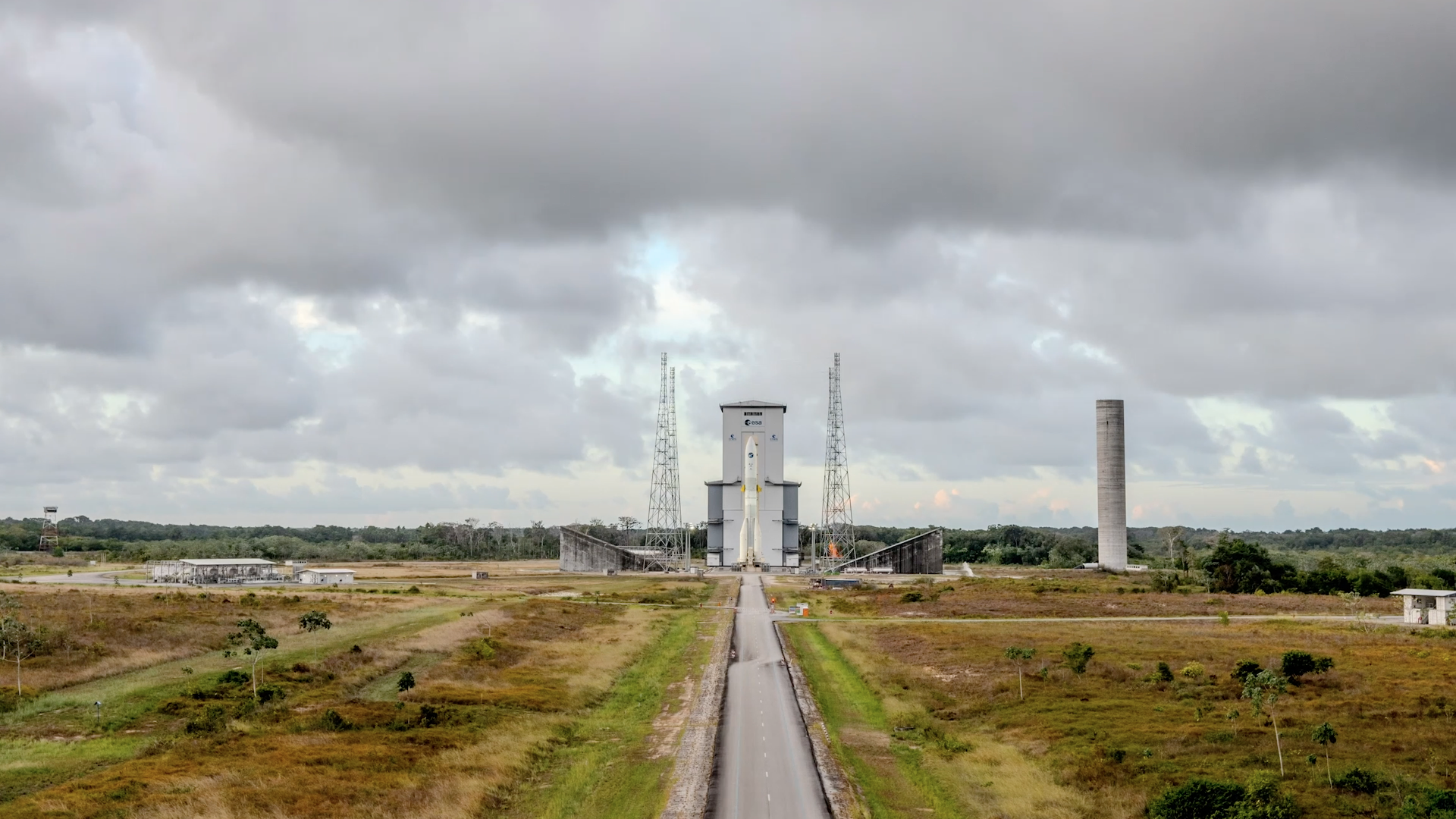

ESA has set a near-term checkpoint for Europe’s next weather-observation mission: MTG-I2 is scheduled to launch on 27 August aboard an Ariane 6 rocket from Europe’s Spaceport in French Guiana. The agency’s 10 August official media invitation is primarily a briefing notice, but it also provides a useful, verifiable account of what the satellite is intended to do—and what is not yet confirmed.
A weather mission with a climate record
MTG-I2 is the third satellite joining the Meteosat Third Generation constellation operated for Eumetsat. ESA says the first MTG-Imager and the MTG-Sounder are already in orbit. The new satellite is another MTG-Imager, designed to add observations for weather forecasting and climate monitoring across Europe and North Africa.
That distinction matters. The announcement is not a claim that a new consumer weather service has gone live, nor does it present a guaranteed improvement for every forecast. It describes an observing system whose data are meant to support forecasters and climate researchers. ESA says the constellation should provide a substantial increase in the quality, quantity and frequency of data, creating new data products and services once the system is fully established.
For a region exposed to fast-moving storms, the practical value is better repeated observation. More frequent measurements can help forecasters follow the development of cloud systems, convection and lightning between conventional forecast updates. They do not remove uncertainty, and the release does not promise that every severe-weather event will be predicted earlier or more accurately.
Two instruments with complementary roles
MTG-I2 carries two instruments. Its Lightning Imager is designed to monitor lightning continuously from geostationary orbit. The official mission image page describes the instrument as capable of capturing individual lightning events by day and night, a capability that can help reveal changes inside developing storm systems.
The second instrument is the Flexible Combined Imager. ESA says it can scan Earth’s surface in 10 minutes and Europe every 2.5 minutes. Those are coverage intervals, not a promise that every pixel or every weather variable is refreshed at the same rate. The point is the combination of broad-area imaging and frequent repeat views, which can give meteorological services more detail about rapidly evolving conditions.
The instruments also serve different time horizons. Lightning and cloud imagery can be valuable for near-term situational awareness, often called nowcasting, while the wider archive can contribute to numerical weather prediction and climate monitoring. The announcement links those uses to the mission’s expected data output; it does not say that MTG-I2 alone will produce a forecast or issue an alert.
Why the orbit is central to the story
According to ESA’s Meteosat Third Generation mission overview, the satellites operate from geostationary orbit, roughly 36,000 kilometres above the equator. From that vantage point, a Lightning Imager can see more than 80% of Earth’s surface visible from the satellite’s position. Staying over the same region also makes it possible to compare successive images and identify motion and change.
ESA expects the full MTG constellation to generate at least 50 times more data than the previous Meteosat Second Generation satellites when it is fully operational. That is a programme-level expectation, not a result already demonstrated by MTG-I2 in orbit. The satellite still has to launch, complete its commissioning and enter service before its operational contribution can be assessed.
Ariane 6’s first geostationary destination
The launch is also significant for Europe’s rocket programme. ESA says this will be the ninth flight of Ariane 6 and the first time the launcher is sent to geostationary orbit. The mission, designated VA270, is planned to use two P120C-based solid-propellant motors during liftoff. These are details of the announced flight profile, not evidence that launch success is assured.
ESA has scheduled online pre-launch briefings for 19 August in English, French and German. The briefings are intended for registered media and are expected to cover the satellite, its instruments and the launch. For readers, the timing offers a clear next checkpoint before the planned 27 August liftoff, while leaving room for the ordinary changes that can affect a launch schedule.
What is confirmed today
The confirmed news is therefore specific: ESA has announced a planned MTG-I2 launch, identified its Ariane 6 destination, described the satellite’s two imaging instruments and set out the weather and climate uses expected from the wider constellation. The official notice does not say that MTG-I2 is already operational, that its data are currently feeding a particular public forecast, or that the launch date cannot change.
That is the useful reading of this announcement. MTG-I2 is not a finished forecasting product being marketed to the public; it is a scientific and operational satellite preparing to add a new stream of observations to Europe’s weather infrastructure. The launch and commissioning milestones will determine when those promised capabilities can be judged against real data.