The European Space Agency has formally adopted Arrakihs, a planned space observatory designed to investigate the faint structures surrounding nearby galaxies. The decision moves the mission out of study and into development: ESA says the feasibility phase is complete and that the agency is committing to build and launch the spacecraft, with liftoff planned by the end of 2030.
That status matters because Arrakihs is not yet reporting a discovery. It is an approved mission with a defined scientific case, an instrument concept and a development path. The announcement gives readers a clear view of what European space science is choosing to measure next—and of the work that still has to happen before any observations can be made.
A mission aimed at the parts of galaxies that are easiest to miss
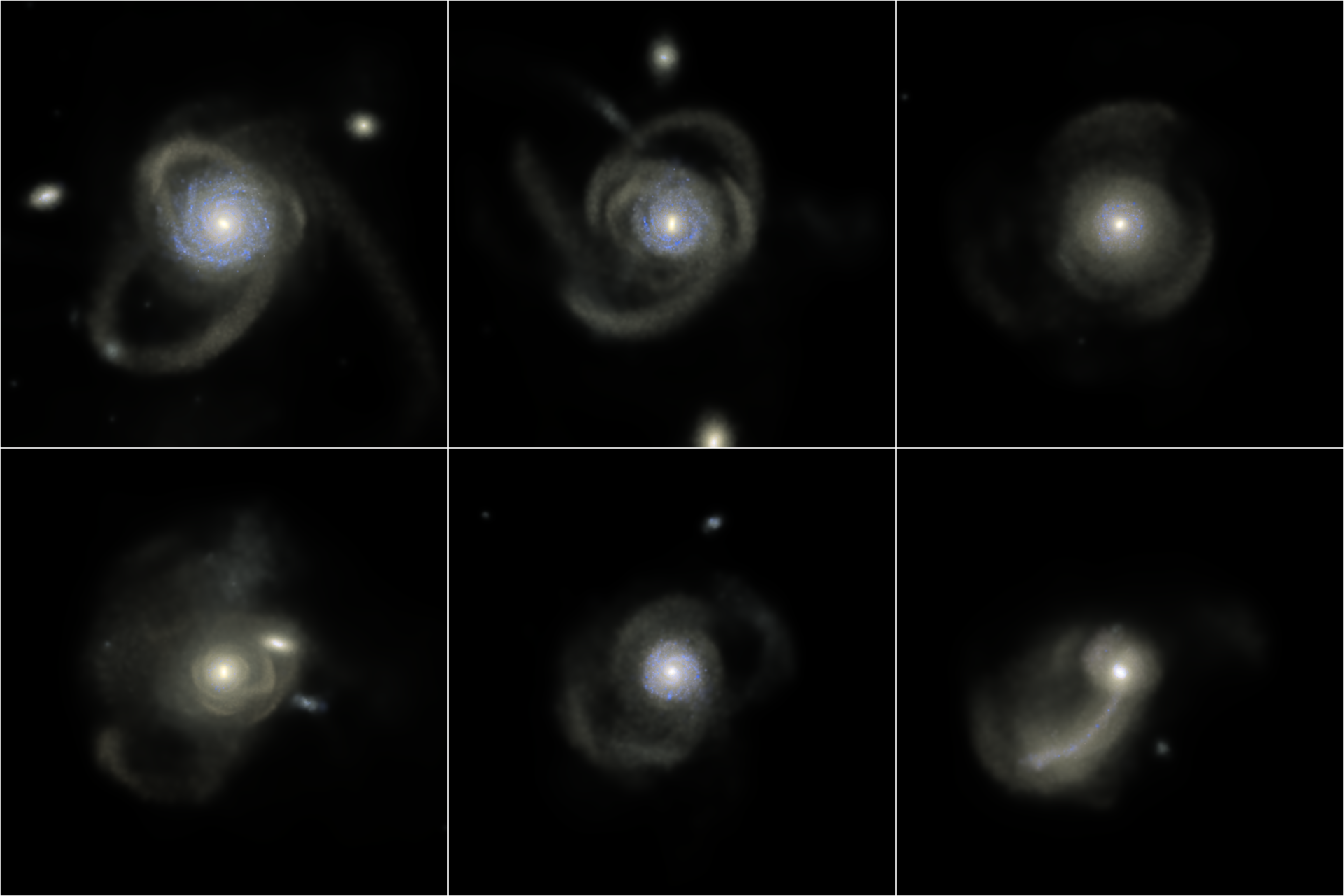
Most familiar images of galaxies show a bright central disc of stars, gas and dust. Arrakihs will look beyond that disc, at the much dimmer halo that surrounds it. ESA describes these haloes as vast regions containing mostly invisible dark matter, along with ordinary matter such as stars and hot, charged gas.
The halo is scientifically valuable because it preserves evidence of a galaxy’s past. Small galaxies and star clusters can be pulled apart by gravity when they merge with a larger system. The debris can remain as thin stellar streams or other diffuse features. Those traces are so faint that they are difficult to detect against the brighter sky background, leaving scientists with limited observations of how common such structures are.
Arrakihs is intended to change that sample size. ESA says the mission plans to study at least 80 nearby galaxies with a mass similar to the Milky Way. Examining a population rather than a single spectacular target should help researchers compare different merger histories and ask whether our galaxy is typical. It also creates a stronger observational test for models of galaxy formation and the role dark matter plays in shaping galaxies.
What ESA has approved
In ESA’s terminology, adoption follows the mission’s study phase. The agency says that phase has shown the concept to be feasible; the next step is to build the spacecraft and its scientific instrument, integrate the systems and put them through extensive testing. The planned launch horizon is therefore a target for a mission in development, not a guaranteed launch date.
Arrakihs is the second fast-class, or F-class, mission in ESA’s Cosmic Vision programme. The class is intended to move from selection to launch in less than ten years by adapting existing technology to a focused scientific objective. Arrakihs was selected in 2022, and the agency says its development is led in particular by Spain. The instrument consortium also includes partners from Switzerland, Austria, Belgium, Norway, Portugal and Sweden.
The observatory will carry one scientific instrument built from two binocular telescopes, giving it four cameras in total. ESA says those cameras will cover wavelengths from the near ultraviolet through visible light and into the near infrared. The combination is intended to reveal extremely low-surface-brightness features and to distinguish the faint light of stellar haloes from the surrounding background.
Part of a wider science programme
Arrakihs was adopted during a meeting of ESA’s Science Programme Committee that also addressed the future of existing missions. In a related programme update, ESA said all 13 missions whose current science phases were due to end before the close of the year would receive extensions. The list includes BepiColombo, Cheops, Mars Express, Solar Orbiter, XMM-Newton and several missions operated with international partners.
The same update recorded a recommendation for the seven-spacecraft Plasma Observatory, which would study how solar plasma transfers energy through Earth’s magnetosphere. ESA said that mission still required a formal decision at a later committee meeting. That distinction is useful: Arrakihs has been adopted, while Plasma Observatory was at the recommendation stage in the announcement.
For Arrakihs, the immediate story is therefore one of commitment and preparation. The mission’s eventual value will depend on whether its instruments can control the difficult background-light problem, complete the planned testing and deliver a statistically useful set of observations. If those steps succeed, the observatory could turn the dim outskirts of galaxies into a much richer record of how cosmic systems assembled.
For now, the evidence supports a narrower conclusion. ESA has approved a feasible mission, assigned it a development route and specified a survey of at least 80 Milky Way-like galaxies. The scientific results remain in the future; the decision to pursue them is the news today.
Read ESA’s official Arrakihs announcement and its programme update on the wider mission decisions for the agency’s full account.