CERN’s CMS experiment has reported a high-precision measurement of a subtle difference between matter and antimatter, offering a new test of the Standard Model rather than evidence of a newly discovered particle. The result examines charge-parity (CP) violation in neutral beauty mesons, particles whose behaviour may help explain why the visible Universe contains far more matter than antimatter.
In its official report published on 17 July 2026, CERN said the CMS Collaboration analysed proton-proton collision data collected at the Large Hadron Collider between 2022 and 2025. The study reconstructed about 1.4 million B0 mesons and 16,000 B0s mesons, two types of neutral beauty meson.
A precise test of a cosmic imbalance
According to established particle physics, the Big Bang should have produced matter and antimatter in nearly equal amounts. Matter and antimatter particles have the same mass but opposite charge, and they should normally be created and destroyed in paired processes. Yet the Universe observed today is dominated by matter. The small differences between matter and antimatter allowed by the Standard Model are important, but they do not fully account for the imbalance.
CP violation is one part of that problem. It describes differences in how certain physical processes behave when particles are replaced by their antimatter partners and spatial directions are reversed. Measuring these effects with greater precision allows physicists to test whether the Standard Model correctly predicts the behaviour of quarks and to look for deviations that could point toward undiscovered physics.
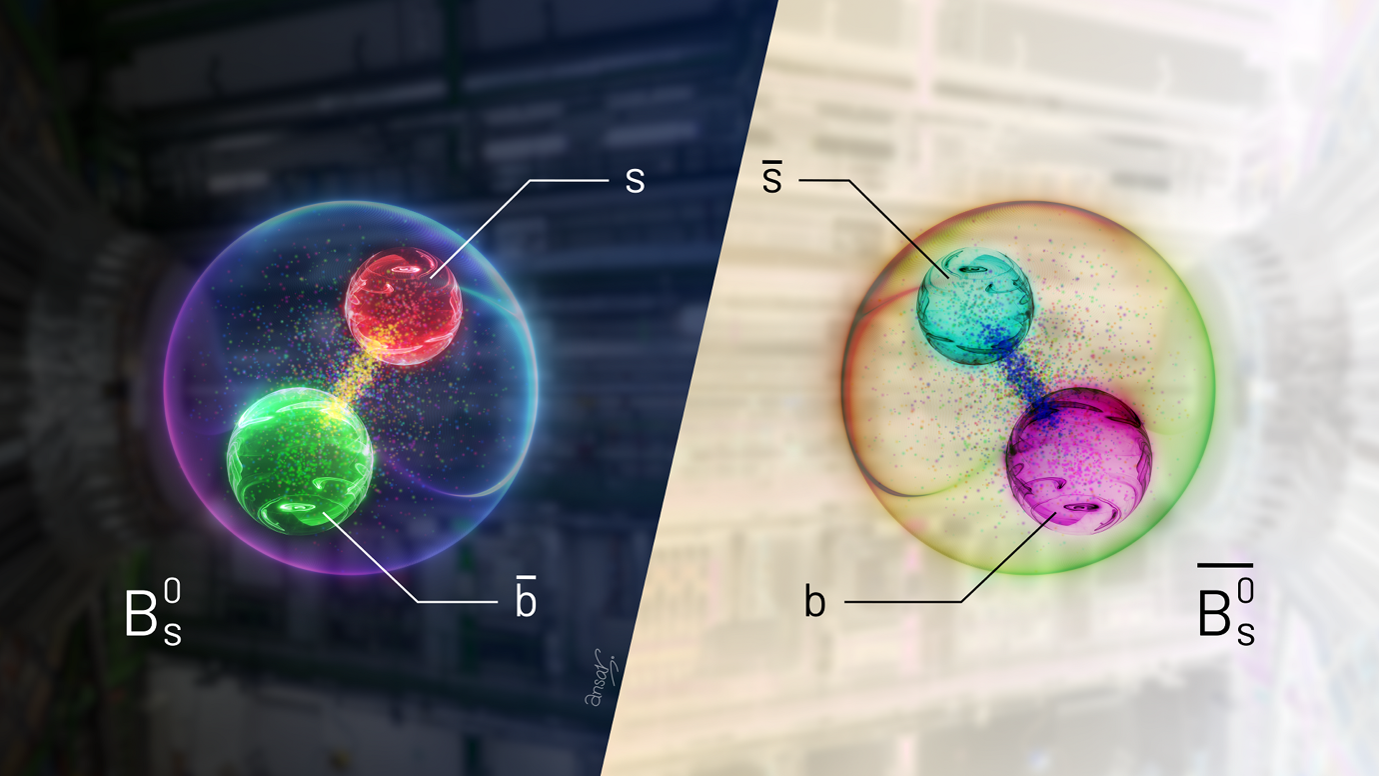
Neutral beauty mesons are particularly useful because they can spontaneously transform into their own antimatter counterparts and then transform back again. That oscillation creates a time-dependent pattern that can be compared for matter and antimatter versions. Any difference in their decay rates or timing can reveal CP violation.
How CMS made the measurement
The CMS analysis focused on specific decays in which the mesons produce a J/ψ particle and a neutral kaon. One of the central challenges was identifying whether each meson began as matter or antimatter before it decayed. That initial identity is not directly visible in the final particles, so the experiment had to infer it from other information recorded in the collision.
CMS used an artificial-intelligence algorithm to improve that identification. The system combined signals from muons, electrons, jets associated with the collision and, for the B0s sample, nearby particles produced in the same event. CERN reports that this approach substantially improved the experiment’s ability to determine the meson’s initial state compared with earlier analyses.
The larger data sample and improved classification method allowed the collaboration to perform a more sensitive comparison between matter and antimatter decays. The work includes what CERN describes as the most precise measurement so far of CP violation in the decay of a B0s meson into a J/ψ particle and a neutral kaon. The accompanying B0 measurement provides an independent test of the same underlying physics.
What the result does—and does not—show
The measured CP violation is consistent with the Standard Model. That agreement strengthens confidence in the theory’s description of beauty-meson decays, while also narrowing the space available for hypothetical new particles or interactions to contribute to the process.
The finding therefore does not solve the matter–antimatter puzzle. It also does not show that the Standard Model contains enough CP violation to explain why matter survived in such overwhelming proportion after the Big Bang. Instead, it improves one of the experimental tests used to understand where the theory succeeds and where additional physics might still be needed.
This distinction matters. A result can be scientifically valuable even when it confirms an existing prediction. Precision measurements establish how closely nature follows the current model and make it harder for possible extensions of that model to hide within experimental uncertainty. If a future measurement reveals a statistically robust departure from the prediction, the comparison will be more meaningful because the baseline has been measured so carefully.
The next step is more data
The Large Hadron Collider is expected to deliver substantially larger datasets during the High-Luminosity LHC era. CMS says future measurements of CP violation in beauty particles will become more precise as those data arrive. They may continue to confirm the Standard Model or expose small deviations that could help identify new particles and interactions.
For now, the CMS result is best understood as a strengthened constraint on one part of the matter–antimatter puzzle. It gives physicists a sharper measurement of a rare and subtle effect, while leaving the larger question of the Universe’s matter dominance open for further experiments.